

Hi friends - Happy Sunday! A couple of weeks ago I had the honor of partnering with the team at Project W again to support their Tech Equity Hub program — an accelerator for women founders of pre-seed B2B software and AI companies who face barriers to networks and capital.
This is one of my favorite events to speak at every single year. The women in this cohort never cease to amaze me with their vision and their tenacity. Many of them are building with less capital, fewer warm intros, and more skepticism than their peers, and they still show up for the challenge and cause.
I shared a short version of my key messages on LinkedIn, and a bunch of you asked me to unpack them. So today, I’m happy to do just that. Pull up a chair. ☕
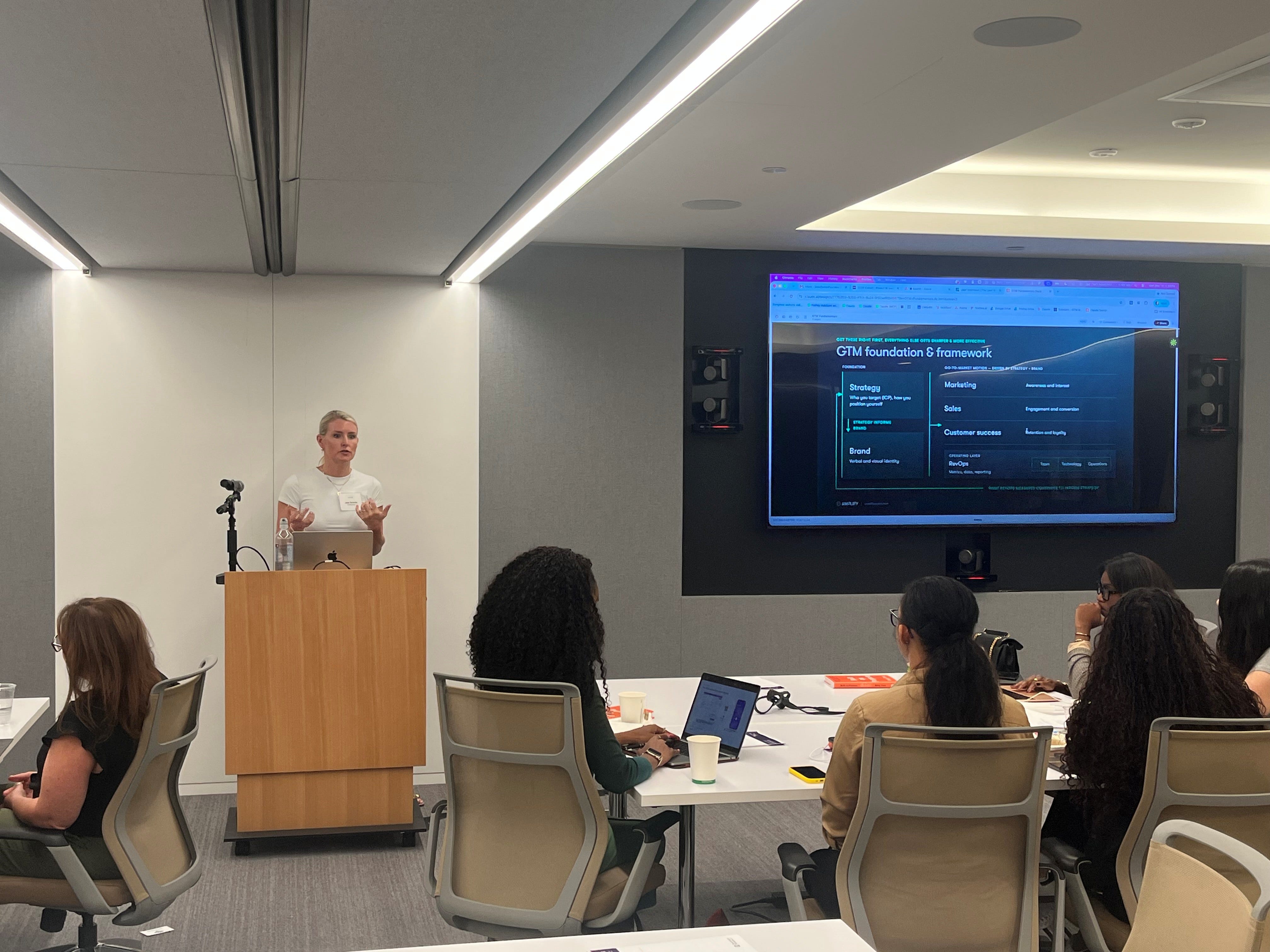
How to win at GTM when AI makes it easy for anyone to start
I went through an extensive deck on GTM fundamentals over 90 minutes, but we’ll just review the three core messages I left the cohort with:
AI has made it easier for anyone to start a business and market a product. So how do you win? Founder-market fit and out-precisioning the competition.
GTM is not easy, but it is simple. Deeply understand the fundamentals and you’ll be able to keep pivoting and iterating your way to success.
Winning in GTM is 50% clarity and 50% consistency.
Let’s take them one at a time.
1. AI lowered the barrier to entry, so how do you win now?
Let’s be honest: AI has made it dramatically easier to spin up a product, a website, a pitch deck, a content calendar, and a cold email sequence. That’s a fact, and it’s mostly great news. It’s also why your buyers’ inboxes, feeds, and search results are noisier than they’ve ever been.
When everyone can look credible, looking credible stops being a differentiator. The question shifts from “can you build and market this?” to “why should I trust you to solve my problem?”
In my experience, the founders who break through that noise win on two things: founder-market fit and out-precisioning the competition.
Founder-market fit
Founder-market fit is the answer to “why you?” It’s the lived experience, the earned insight, the network, and the credibility that make you the right person to solve this specific problem for this specific buyer. AI can write a post about your industry. It can’t have spent 10+ years living inside it.
It also shows up in a very practical place: your first customers. Your first logos come from your network — people who already know, like, and trust you. Someone without founder-market fit will often struggle quite a bit to land those first logos.
And those first wins are what earn you the next conversations — the ones with people who don’t know or trust you yet.
Here’s the thing — most founders have founder-market fit and do a poor job of exploiting it. They lead with product features instead of the story of why they started, what they saw that others missed, and who they’ve already helped. Your story and your point of view are GTM assets. Use them.
This is exactly why I keep beating the founder brand drum. If you want to go deeper:
Founder Thought Leadership Strategy: Part 1 of 4 — why YOU are your best sales and marketing engine and how to optimize your profile
Why you should invest in thought leadership (again) — why human voices win trust as AI content grows
Out-precisioning the competition
If you can’t out-spend the competition (and often, you can’t), you can out-precision them. That means knowing your buyer better than anyone else does — who they are, what’s breaking for them right now, what signals tell you they’re ready, and exactly what language they use to describe the problem.
Here’s the gut check I gave the cohort: the earlier you are, the more your ICP should give you FOMO. A narrow ICP means saying no to accounts you could probably win — and that discomfort is the signal you’ve defined it tightly enough (for now).
“We sell to enterprise HR departments” is too broad to prioritize an account list, write a sequence, or brief an AE. Every company qualifies, so none of them do. Compare that to: “We sell to large, self-insured enterprise employers — US HQ, 10k+ employees, a Director of Benefits who’s been in the role at least three years, and Tier 1 industries of professional services, healthcare, and retail.” Now you can actually build a list.
Then layer in signals. Characteristics tell you who to pitch. Signals tell you when. A new CRO, a funding round, a hiring surge, repeat visits to your pricing page — those are the moments a well-fit account becomes a ready-to-buy account.
Precision is what lets a scrappy team with a small budget land a message that feels like it was written for one person — because it was.
Where to go deeper:
How to properly define your ICP — the North Star for everything else
Bullseye, baby — How to refine your buyer personas — going beyond job titles
Leveraging AI to refine your ICP & buyer personas — using AI for precision, not just volume
Signal-based GTM: what it is and how to get started — precision over volume, in practice
2. GTM is not easy, but it is simple
I say this in almost every room I teach in, and I mean it. GTM is hard work — there’s no easy button. But it isn’t as complicated as you may think.
Here’s what I mean…
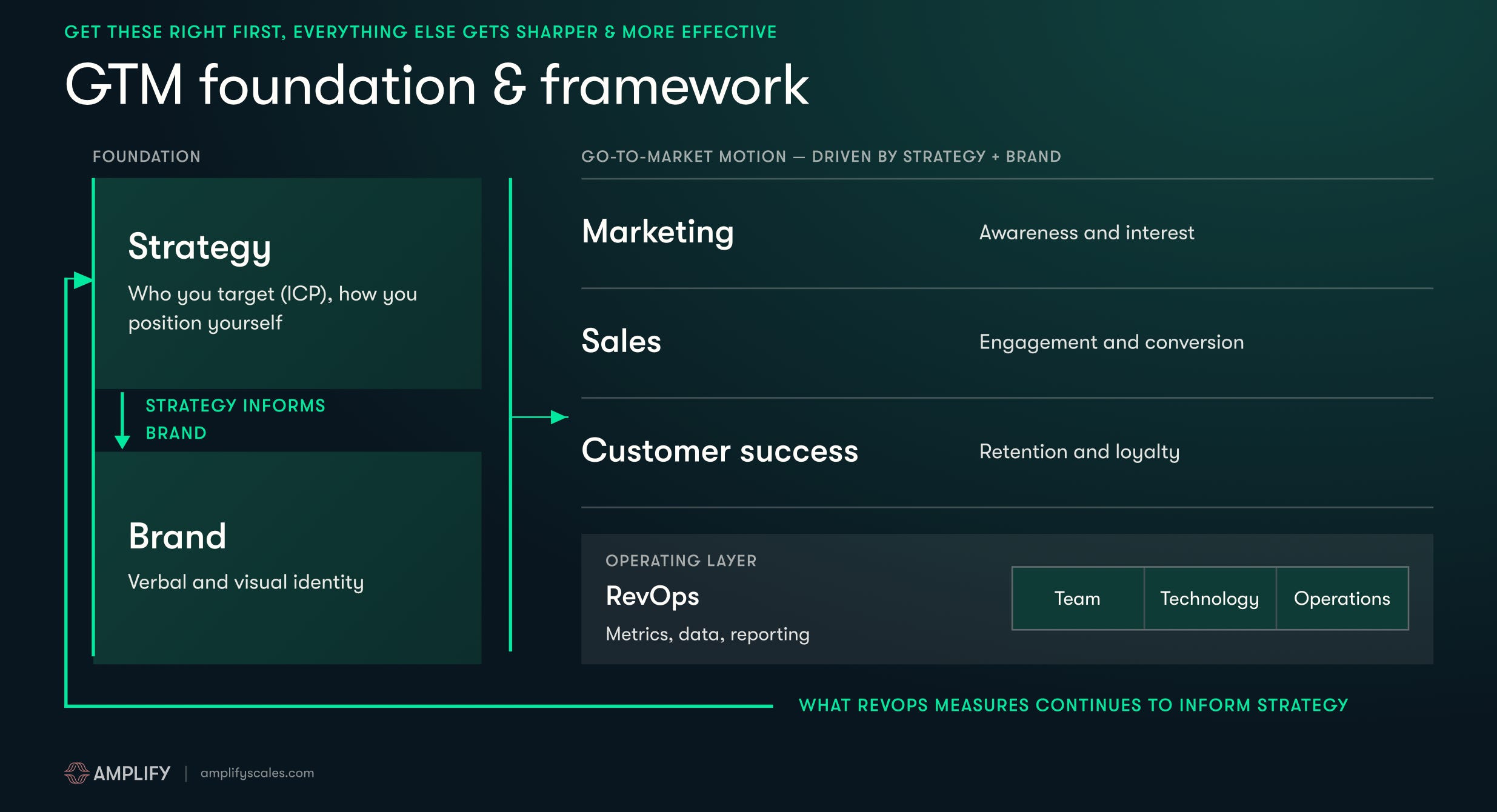
Every GTM motion sits on the same foundation: strategy (who you target and how you position yourself) informs your brand, and together they drive marketing, sales, and customer success. RevOps sits underneath, measuring what’s working — and what it measures feeds right back into your strategy - helping you continue to refine and iterate.
And when it comes to pipeline, all revenue comes from four buckets, all with a different level of quality and effort:
Organic — existing customers, referrals, renewals, upsell. Highest quality, lowest effort.
Nearbound — ecosystem partnerships. Borrowed trust at scale.
Inbound — website, content, social, SEO, paid, PR. Slow to start, hard to stop.
Outbound — cold outreach. Fast to turn on, but low quality.
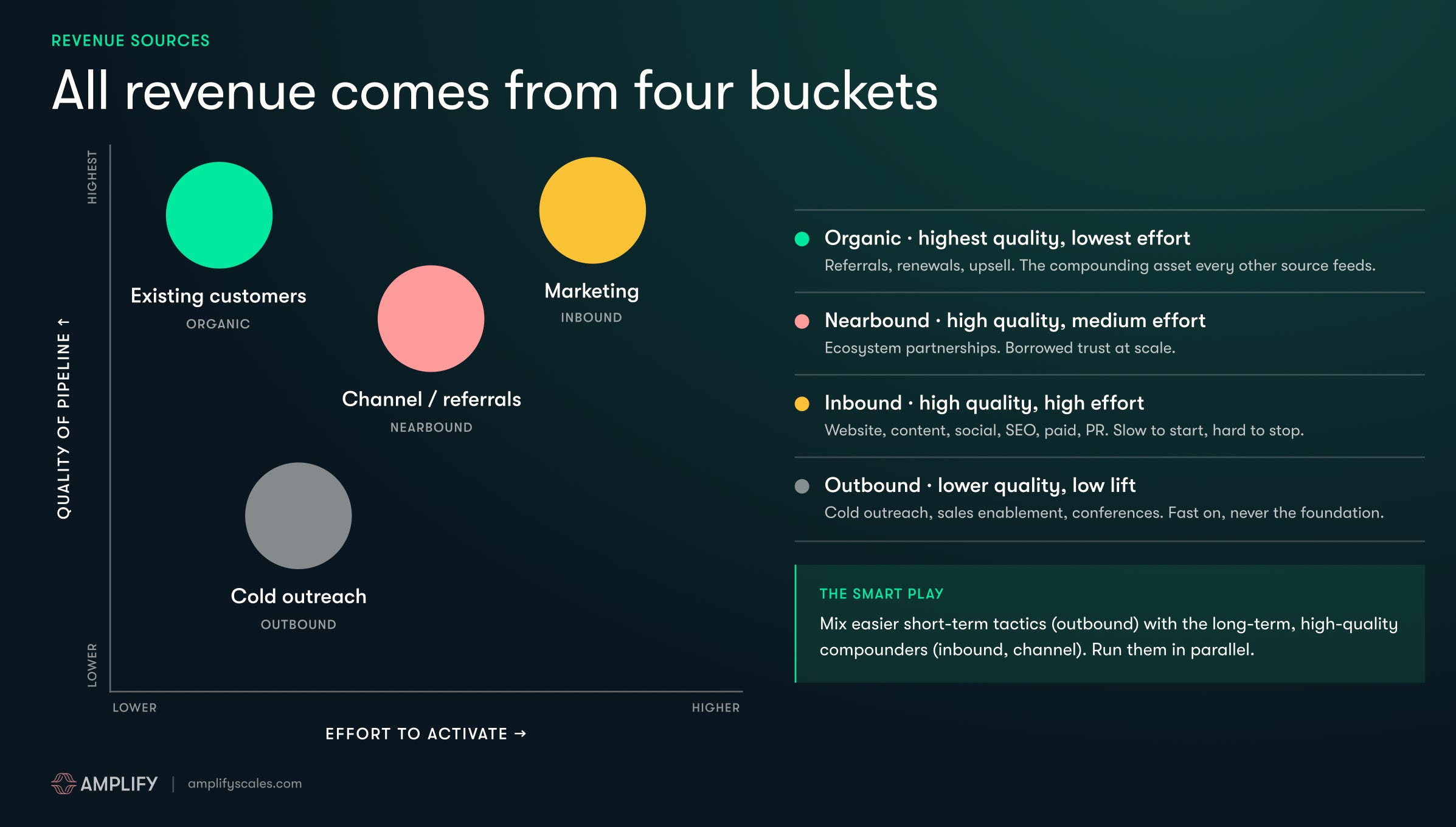
That’s it. There’s a finite list of tactics inside those four buckets, and your job is to pick the few that match how your buyers actually buy — ideally mixing faster short-term plays (outbound) with the slower, higher-quality compounders (inbound, channel) in parallel.
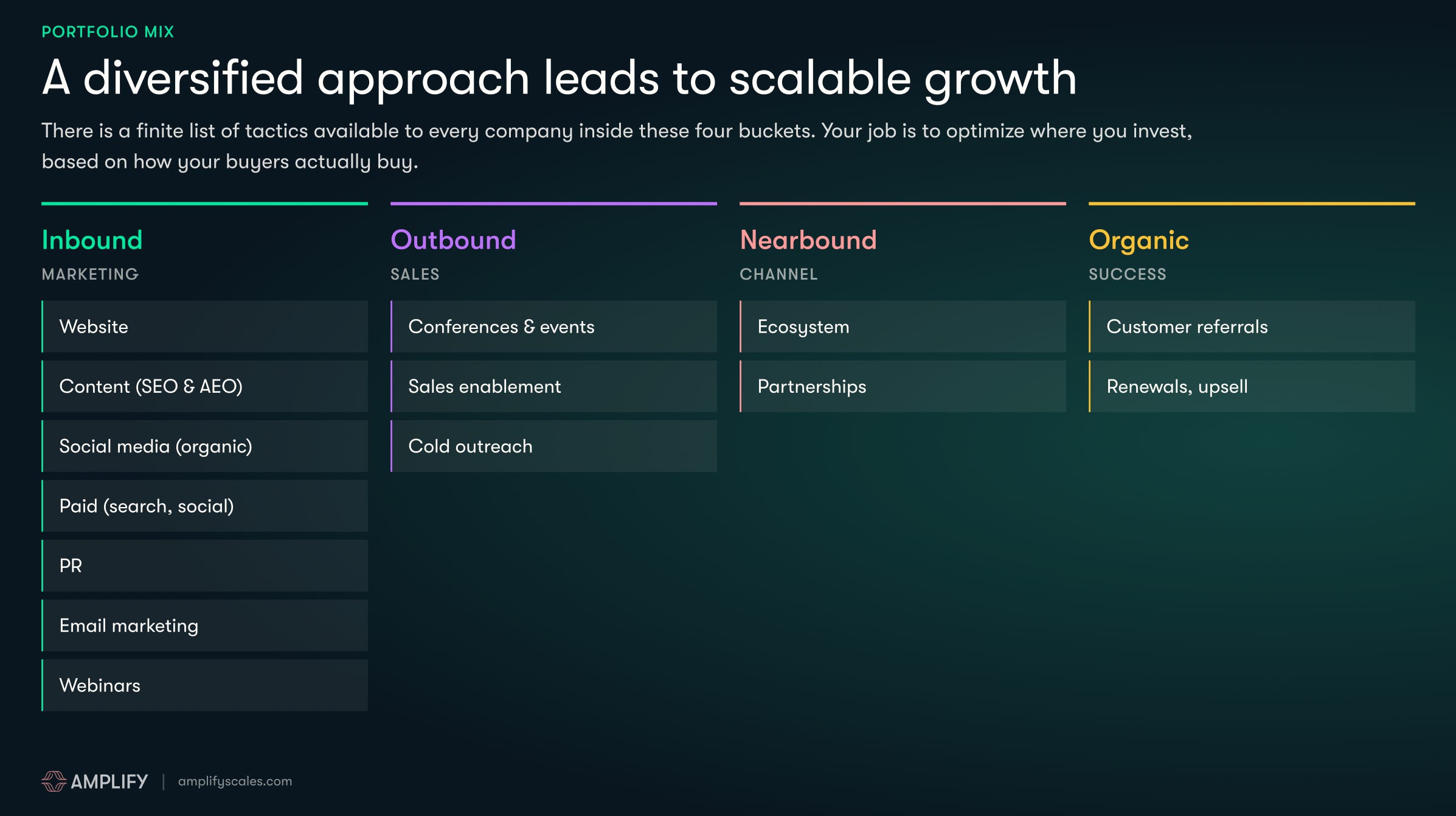
What changes constantly are the execution tactics — the tools, the channels, the algorithms, the shiny new thing everyone is talking about this quarter. Founders who chase tactics or tools without the fundamentals tend to get whiplash or run out of cash. Founders who understand the fundamentals can swap execution tactics or tools in and out without losing their footing or effectiveness.
That’s the real advantage. When a channel dries up or your first ICP hypothesis turns out to be wrong (and very often, it will be — that’s normal!), the fundamentals are what let you pivot and iterate effectively. Which is why, early on, I tell founders to treat every sales call as a learning lab. Record them, review them monthly, and note the objections that keep coming up (three is a pattern). Before you optimize for close rate, optimize for learning.
Where to go deeper:
Part I: How to build your GTM strategy — who you target and how you differentiate, before channels
Part II: How to build your GTM strategy — the non-negotiables, then 3–5 tactics that fit your ICP
The 3 GTM foundations founders build too late — why the fundamentals get more expensive the longer you wait
Why RevOps is your secret weapon (for both humans and AI) — the foundation that makes learning and iterating possible
3. Winning in GTM is 50% clarity and 50% consistency
This is the one I hope sticks with you the longest.
Clarity
Clarity comes in three parts:
Who you’re selling to — a sharp, specific ICP and buyer persona
How you position yourself — why you, why now, and how this is different from what they’re doing today
How you’re going to reach them — the handful of channels where your buyers actually spend their time (and trust)
If any one of those is fuzzy, everything downstream gets harder. Your website doesn’t convert, your outreach doesn’t land, and your content doesn’t find its intended audience. Clarity is the work you do before you turn up the volume.
One positioning nuance that came up a lot with founders, is that your position can and should change over time AND the position you sell to investors is and should be different from the position you sell to prospective customers.
To investors, sell the vision: where this goes and how big it gets. To customers, sell who you are today: the narrow, provable problem you solve for them right now. Position #1 earns you Position #2, and so on, until you own the category you’re aiming for.
Founders get into trouble when they pitch the vision to a buyer who just needs their problem solved this quarter.
Where to go deeper:
Positioning: the five components, and why one version is never enough — the positioning framework, step by step
How to nail your sales pitch: A framework to build it — turning your positioning into a pitch that lands
Your GTM approach needs to match your ICP — why a $10K SMB deal and a $100K enterprise deal need different motions
Consistency
Once you have clarity, the rest is consistently showing up — every day and every week. Posting, emailing, following up, hosting, sharing what you’re learning. Not in bursts when you have time, but on a rhythm you can actually sustain.
Here’s the reality: not everyone is in market to buy today. Very often in my experience, the majority of the people who see your content or hear your pitch aren’t ready yet. But if you’re consistent and clear, you’re the one they remember when they are.
The way I framed it for the cohort: get them into your orbit, then keep them there until they’re ready to buy. Founder-led thought leadership and podcast guest appearances get you into their orbit. Email keeps you there — and it’s the only channel no algorithm can take away from you, so start the list before you think you need it.
And consistency isn’t about more discipline. It’s about building a sustainable system so showing up doesn’t depend on motivation.
Where to go deeper:
Mindshare earns you market share — be obnoxiously visible (in a helpful way)
Everyone (successful) has a system — three models to stay consistent without burning out
Two simple ways to do PR (without a $5–10k/month agency) — the podcast guesting playbook
Email Marketing FTW: The playbook — how to build and nurture the audience you own
Where to start
If you only do one thing this week: write down who you sell to, why you’re the right person to solve their problem, and the one or two places you’ll show up consistently for the next 90 days. If you can’t write those three answers yet, that’s your homework — and it’s the most valuable GTM work you’ll do this quarter.
Clarity first. Then consistency. You’ve got this!! 🎯
Bring this to your founders
Sessions like Tech Equity Hub are some of my favorite work. Over the last four years I’ve taught 50+ masterclasses and workshops for programs at Kellogg, the Polsky Center at the University of Chicago, Motivate Ventures, and Amex Ventures, to name a few — always practical, always tactical, and always tailored to where the founders in the room are today.
If you run an accelerator, a VC platform team, or a university entrepreneurship program and you’re looking for a GTM speaker for your founders, I’d love to hear from you.
And a huge thank you again to the Project W team for creating a room like this. ❤️
With love and gratitude -

If you want to learn more about working with me directly…
For B2B startups, we serve as your Fractional GTM executive or engineer. Learn more about -
When you’re ready, let’s connect to discuss your specific growth goals and challenges.
Subscribe for weekly education, ideas, and frameworks
In this newsletter I share the exact tips, playbooks, and GTM multi-vitamins I’ve used to help 30+ B2B startups scale their revenue 150-590% YoY.