

Hi friends - Last week we worked through the components of positioning — what it’s made of, where you start, and why one version is never enough.
The sales pitch is the natural sequel. Positioning is the thinking and foundation. The pitch is how you deliver it out loud, in a room, to a person who has forty other things on their mind. And in my experience, that translation step is where a lot of the good work gets lost.
Most of the sales decks I get handed are product and feature dumps. Logo slide, team slide, then twenty slides of features and screenshots. There’s no zoom-out, no bigger “so what,” and no help for the buyer trying to figure out where you fit and why you’re the better choice.
It’s a structural problem and it’s fixable.
How to nail your sales pitch: A framework to build it
Credit where it’s due
I’m going to hand it to April Dunford twice in two weeks, and I am honored to do it.
Her second book, Sales Pitch, lays out a structure for the pitch itself, and her episode on Lenny’s Podcast walks through it if you want the quick overview.
Here’s my honest reaction to reading it: oh, these are the things I’ve always done. Not because I’m a genius — because when you’ve sat in enough sales conversations, you learn through trial and error that opening with your product doesn’t work, and that buyers relax when you talk honestly about their other options — including where or when you’re not the right fit. I’d arrived at most of these pieces by instinct over the years and never named them.
What April did was codify it. She gave structure and sequence to a thing I was doing loosely, which is exactly what makes it teachable — and coachable to someone who hasn’t yet sat through those hundreds of conversations. Having the GOAT of positioning validate the instinct was nice. Having her turn it into a repeatable framework is incredibly helpful.
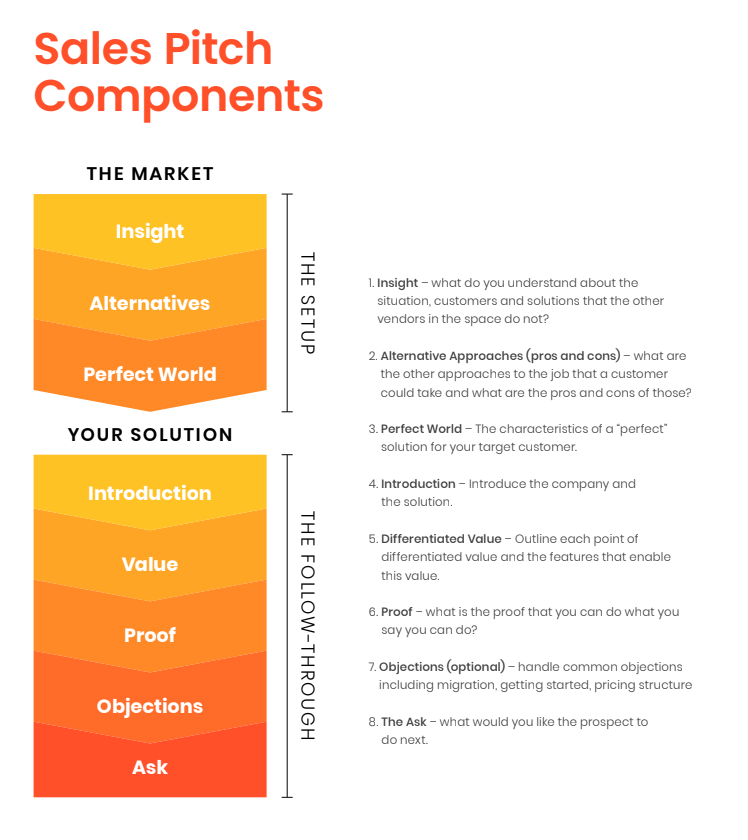
So this is the framework I use with clients to shape the sales pitch once we’ve finished the positioning work, and it’s the same sequence I use to rebuild their sales deck.
Why the feature dump fails
Before the components, it’s worth being clear about what you’re actually up against.
In The Jolt Effect, Matt Dixon and Ted McKenna analyzed over 2.5 million recorded sales conversations and found that somewhere between 40% and 60% of lost deals ended in no decision — not a loss to a competitor, but the buyer doing nothing at all. And of those, more than half came down to indecision and fear of getting it wrong, rather than a simple preference for the status quo.
Read that again in the context of your deck. Your most likely outcome isn’t losing to a competitor. It’s a buyer who liked you, but couldn’t get confident, and quietly stopped replying.
A feature dump makes that worse. It hands an already-overwhelmed buyer more to evaluate without helping them through the evaluation. A structured pitch does the opposite — it gives them a way to think about the whole category, an honest read on their options, and a clear path forward.
This gets more important the further upmarket you sell because the stakes are higher and the buying committee is bigger. An enterprise buyer isn’t just deciding whether to buy; they’re building an internal case they’ll have to defend to people who weren’t on your call. If your pitch doesn’t give them the frame, the comparison, and the proof, they have to build it themselves — and most won’t.
The setup: talk about the market before you talk about you
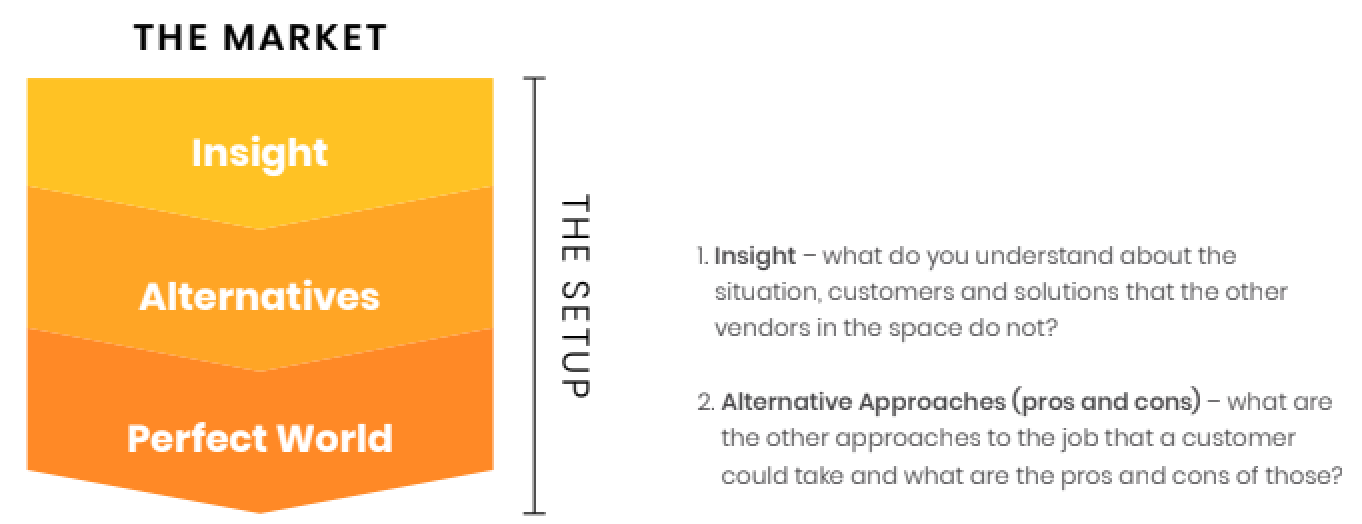
The first half of the pitch isn’t about your company at all. It’s about the market and your point of view on it. Where it’s broken, underserved, or where there is a new opportunity to capture.
Insight. What do you understand about this problem, these customers, or this space that the other vendors don’t? This is the thing that makes a buyer lean in and think huh, I hadn’t framed it that way. It’s also the hardest one to write, and the one founders most often skip because it feels indulgent. It isn’t. It’s the reason they keep listening.
Alternatives. Lay out the approaches a buyer could take to solve this — with real pros and cons for each. Yes, including the ones that aren’t you. This is where last week’s competitive alternatives work pays off: doing nothing, building it internally, hiring someone, stitching together point solutions, or buying a vendor like you.
It feels like handing the buyer reasons to leave. In practice it does the opposite — it’s the single fastest trust-builder in the pitch, because you’re the only person being straight with them about the trade-offs. And you get to frame the comparison rather than letting the buyer or a competitor frame it for you.
Perfect world. Given everything you just laid out, what would the ideal solution look like? Not your product — the characteristics of a perfect solution for a customer like them. Done well, the buyer is nodding along and building your requirements list in their head before you’ve shown a single screen.
That’s the whole setup, and it should happen before you introduce your company.
The follow-through: now you can talk about your solution
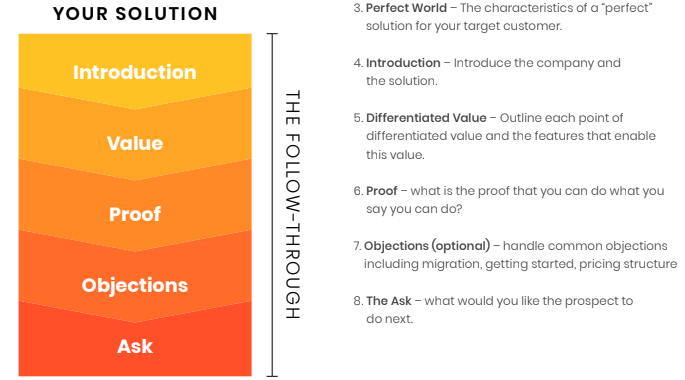
Introduction. One clean line on who you are and what you do. Not a history lesson.
Differentiated value. Walk each point of value you deliver and the features that enable it — in that order. Value first, feature second, as evidence. This is where most decks invert the logic and lose the room.
Proof. What’s the evidence you can do what you just said? Customer stories, data, references, benchmarks. If you’re early and thin on proof, this is where I’d highlight your team’s resume, your institutional investors, and any early client logos.
Objections. Optional, but I almost always include it. Migration, implementation lift, pricing structure, security — raise the objection before they do. Dixon’s research on indecision is the argument for this: you are not creating doubt by naming it, you’re removing the fear that you’re hiding something.
Ask. What do you want them to do next?
Where I push past the framework: make the ask a process
The ask is the part I expand with every client.
Most pitches end with something like “let us know if you’d like to move forward,” or a demo offer with no shape to it. That’s not an ask — that’s leaving the hardest part of the deal to the person with the least experience buying your product.
Remember what the research says: your buyer’s most likely failure mode is freezing. A vague ask is an invitation to freeze.
So instead of a single next step, I have clients put a concrete buying process in front of the prospect. Name the steps, say what happens in each one, and say what the prospect gets out of it.
Something like:
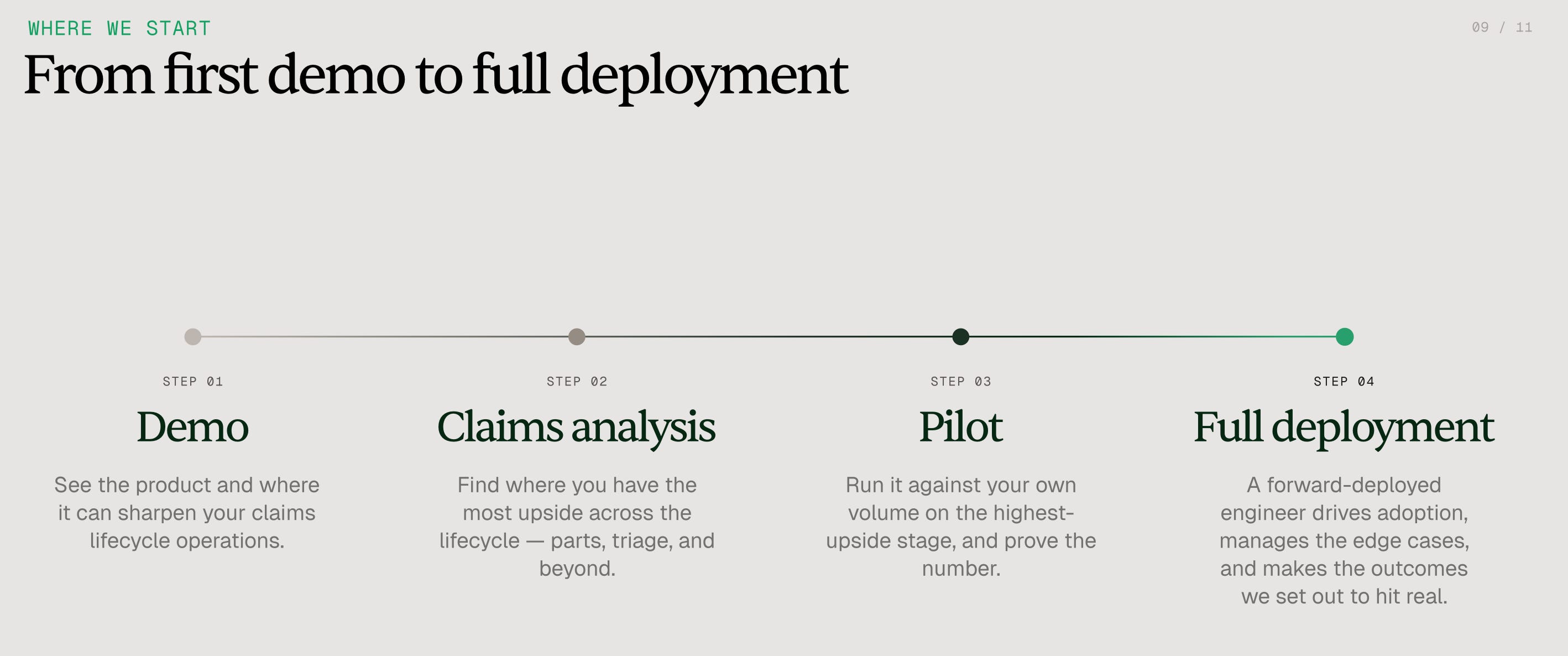
Step 01 — Demo. See the product and where it fits your operation. Verbally, we encourage them to invite all key stakeholders to this demo, too. Legal, procurement, ops, etc. Something like “In our experience, we can all reach a yes or no much faster if we include your full team from the beginning – it will save us both 6 months regardless of the outcome”.
Step 02 — Analysis. We look at your actual data and find where the upside is biggest. If you have a way to perform some kind of data driven analysis for your sales process - DO IT.
Step 03 — Pilot. Put it in their hands. Let them experience it to see the value.
Step 04 — Full deployment. We drive adoption, handle the edge cases, and make the outcome real.
Your steps might look different but the important part is that the steps are deliberate, each with a purpose and a deliverable. Your buyer now has something they can screenshot and forward internally — which is exactly what happens to it.
Three things this does that a vague ask doesn’t:
It removes ambiguity. They know what they’re agreeing to next and why. They feel guided.
It de-risks the decision. Nobody is being asked to bet the department on slide 12. They’re being asked to take one small, bounded step next.
It gives you a shared plan. Sales teams call this a mutual action plan, and it’s one of the more reliable forecasting tools you’ll have. If a prospect won’t agree to step one, you’ve learned something valuable early instead of six weeks from now.
Build the version that matches how people actually buy your product — length, sequence, who needs to be in each step. Then use the same one every time so you can tell the difference between a deal that’s moving and a deal that’s stalled.
What this means for your deck
Your deck should follow this sequence, not your product’s architecture.
Practically, that usually means: a few slides of market point of view, a genuine alternatives comparison, the “here’s what good looks like” slide, then your company, then value with features as supporting evidence, then proof, then the objections you know are coming, then the buying process.
The product screenshots don’t disappear. They move, and they get demoted from being the argument to being the evidence for the argument.
And to be clear — I’m not telling you to throw away the twenty product slides you already built. Keep them. Move them to an appendix behind the buying process slide, or pull them into a separate product overview deck entirely.
There’s a real reason to hold onto them. The deck you present and the deck you send afterward are doing two different jobs. Live, you want the narrative — tight, sequenced, no detours. But that deck gets forwarded, and the people it gets forwarded to weren’t on the call. They didn’t hear you talk through it. Having the detailed product content sitting in the back gives your champion something concrete to point at when the security lead or the ops manager asks a specific question you never got to.
So build the core deck to the pitch structure, and let the appendix carry the depth. You control what you walk through in the room; they get the reference material for the conversations that happen after you leave it.
One more thing worth saying: this should become a sales enablement asset, too. Write it down so the first rep you hire can run it without you in the room.
Founder self-check
Does your pitch say anything about the market before it says anything about your product?
Can you name the three or four alternatives your buyer is weighing — out loud, in the pitch, with honest pros and cons?
Does your deck lead with value and use features as proof, or lead with features and hope value is implied?
When you finish a first call, does the prospect know exactly what the next three steps are?
Could someone who isn’t you deliver this pitch on Monday?
Where to start
Good. Write the setup only. Three sections — insight, alternatives, perfect world — one page total. Deliver it verbally on your next five calls before you open the deck at all, and watch what happens to the conversation.
Better. Rebuild the deck in this sequence and add your buying process as the closing slide. Give yourself an afternoon; you’re mostly reordering and cutting, not creating.
Best. Turn it into enablement. Script it, record yourself delivering it, and document the buying process with what happens at each step and who needs to be involved. Then test it — April’s own advice is that a pitch is a hypothesis until you’ve run it enough times to know which parts land.
How will you know if it’s landing? You will literally see it in the buyer’s body language. They will nod, they will smile or laugh at some parts, they will lean in, they will relax.
If you make these changes and it works, I’d love to hear about it.
With love and gratitude -

If you want to learn more about working with me directly…
For B2B startups, we serve as your Fractional GTM executive or engineer. Learn more about -
When you’re ready, let’s connect to discuss your specific growth goals and challenges.
Subscribe for weekly education, ideas, and frameworks
In this newsletter I share the exact tips, playbooks, and GTM multi-vitamins I’ve used to help 30+ B2B startups scale their revenue 150-590% YoY.
I think understanding what the market actually needs is crucial. If you pitch the product before the buyer sees the need for it, even a good product can feel pushy. The part about showing the value first makes a lot of sense for this reason.