

Hi friends - Happy Sunday! In my last article, we went deep on one specific competitive alternative — the internal build.
Today I want to zoom back out and walk through: what positioning is actually made of, where you start, and why a single positioning statement is almost never enough.
This is the part most founders don’t spend enough time on. SaaS positioning gets treated as a copywriting exercise — you write one line, put it on the homepage, hand it to your first rep, and then wonder why it lands with some buyers and bounces off others.
It may not be a messaging problem, but rather that one statement is being asked to do the work of four or five different jobs. Let’s dig in!
Your positioning isn’t one statement
Start with the core components
I use April Dunford’s framework religiously, and I’d encourage you to go straight to the source — her book Obviously Awesome is the best 10-15 hours you’ll spend on this topic, and her episode on Lenny’s Podcast is a great free version if you want the information faster.
Her framework breaks positioning into five components:
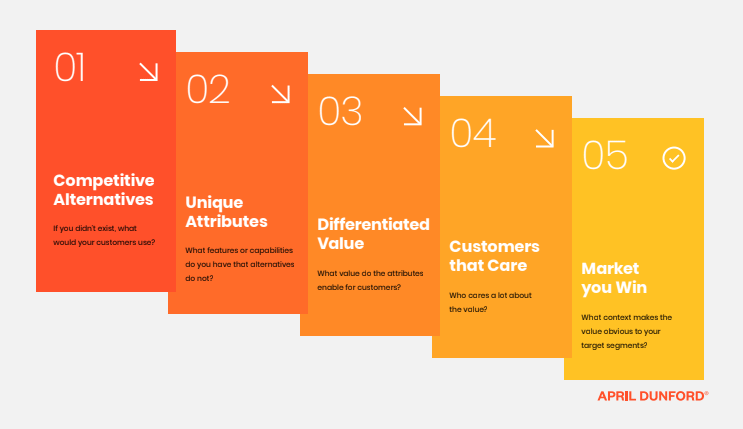
Competitive alternatives — if you didn’t exist, what would your customers use?
Unique attributes — what features or capabilities do you have that those alternatives do not?
Differentiated value — what value do those attributes actually enable for customers?
Customers that care — who cares a lot about that value?
Market you win — what context makes that value obvious to the people you’re targeting?
The sequencing here matters a lot. Each one is derived from the one before it. You can’t name what’s unique about you until you know what you’re being compared to, and you can’t claim differentiated value until you know which of those unique things a buyer would actually pay for.
One note if you go read the book: her full process actually starts one step earlier, with the handful of customers who already love you. You look at what they genuinely considered before they found you, which is how you get an honest list of alternatives instead of the one you’d write from memory. Which, conveniently, is exactly where this whole thing is headed.
So let’s spend most of our time on number one, because that’s where I see the most expensive mistakes.
Competitive alternatives: you’re competing with more than vendors
When most founders write competitive positioning, they write it against other vendors. Logo grid, feature comparison table, us versus them.
That’s a fraction of the choice set actually sitting in front of your buyer. In my experience, the real alternatives look more like this:
Doing nothing. The status quo is the most under-rated competitor in B2B. Spreadsheets, a shared inbox, a process that’s annoying but survivable. Nobody gets fired for keeping things the way they are, which is exactly why so many deals die here. Your job is to help them quantify what staying put actually costs — that’s the whole cost of inaction argument, and it’s often a stronger case than your ROI math.
Building it themselves. This one has changed the most in the last 18 months, which is why it got its own article. Short version: AI compressed the build, it didn’t compress the cost of ownership. Your argument is no longer “this is hard to build,” it’s “this is hard to own.”
Throwing people at it. A lot of the time you’re not competing with software at all. You’re competing with a headcount req, an offshore team, a contractor, an agency, or an ops person who’s “just going to handle it for now.” This comparison is very winnable — your annual contract value against a loaded salary is usually a favorable trade — but only if you make the comparison explicitly. If you don’t bring it up, your buyer is doing that math privately and you never get to weigh in.
Point solutions versus your broader platform — or the reverse. If you sell a platform, you’re often competing against a buyer stitching together three cheap tools they already have. If you sell a point solution, you’re competing against the suite they already pay for that does 60% of what you do, badly, for free. Both are real competitors and neither shows up on a G2 grid.
And then, finally, your direct competitors. Which is where most of your positioning energy currently goes, and where the smallest share of your lost deals actually happen.
How to find out what you’re really up against
You don’t have to guess at this. These things work:
Ask your existing customers. What else did they compare you to? Why did they ultimately choose you vs that solution? What pushback or objections did they have to overcome internally to get consensus? Bonus: use this interview to capture a case study at the same time.
Ask it directly in discovery. “If you don’t solve this at all this year, what happens?” and “What would you do about this if we didn’t exist?” You’ll get the real alternative set in about 30 seconds.
Go read your closed-lost reasons. If your CRM says “lost to competitor” on most deals, your loss reasons aren’t specific enough to be useful. A quarterly win/loss review is the cheapest positioning research you’ll ever do.
One more thing worth noting: your alternative set changes by segment. A 5,000-person enterprise with an engineering team considers building. A 40-person company considers doing nothing or hiring someone. Same product, entirely different thing to argue against. Hold that thought, because it’s where we’re going next.
Then work through the rest
Once you know the alternatives, the other four components get much easier to answer honestly.
Unique attributes are only unique relative to that set. “Real-time reporting” is not unique if every vendor has it — but it might be genuinely unique versus the spreadsheet and the part-time analyst, which is who you’re actually up against.
Differentiated value is the translation step, and it’s where most positioning dies. An attribute is a fact about your product. Value is what that fact does for a human being at work. Nobody buys “automated reconciliation.” They buy not having to spend the first three days of every month closing the books.
Customers that care is your ICP — but arrived at from the other direction. Instead of starting with firmographics and working forward, you start from the value and ask who is desperate for it. Usually it’s a narrower group than you’d like, and that’s the point.
Market you win is the context you put yourself in so the value is obvious immediately. It’s the “we’re the X for Y” instinct, but done deliberately — picking the frame where your differentiated value is the most important thing in the room rather than a nice-to-have.
Your positioning can and should change over time
Here’s the part I want early-stage founders to actually internalize: positioning is not a permanent decision. It’s a claim you can defend right now, with the evidence and resources you currently have.
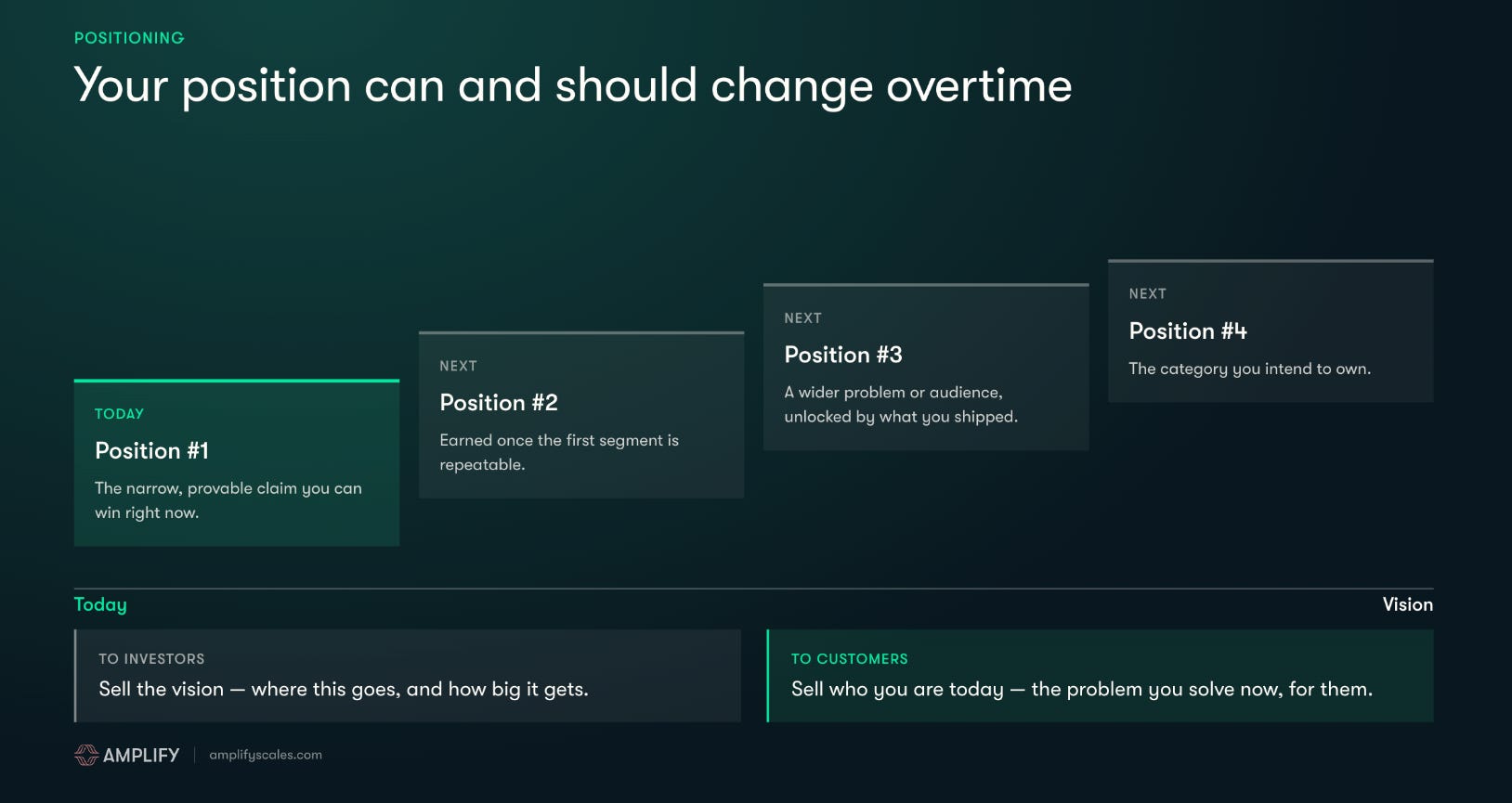
The earlier you are in your GTM maturity, the narrower and more specific your position and your ICP should be. Not because narrow is better, but because narrow is manageable and provable. You have a handful of customers and a small team. You can’t credibly claim a broad category, and you don’t have the capital or people to sell into one.
So you take the narrow, provable claim you can win today. You earn repeatability in that segment. Then you expand into the wider problem or the adjacent audience that your first win unlocked — and you keep going until you’re positioned in the category you actually intend to own.
One important nuance: you sell the vision to investors and you sell today to prospective customers. Investors are buying where this goes and how big it gets. Customers are buying the problem you solve right now, for them. Founders get into trouble when they take the investor pitch into a sales call, and the buyer hears a company trying to be everything instead of a company that solves their specific, painful, expensive problem.
One product, two ICPs, two entirely different reasons to buy
Now the part that trips up most founders selling into more than one segment.
If you have more than one ICP, you need positioning for each one. Not a different product. Not different pricing, necessarily. A different argument.
Your product performs a set of jobs and has a set of features. But different ICPs care about wildly different subsets of that list — and the alternatives they’re weighing you against are different too.
Here’s an example of this from when I was selling PEO services at TriNet. Same company, same service, two SMB segments that bought the same “product” (HR in a box) for entirely different reasons.
White collar tech and professional services businesses generally bought us for benefits and geography. Better health plans at a better price than they could get on their own, and — often the bigger driver — they were hiring across multiple states and didn’t want to stand up payroll registration, state filings, and multi-state compliance themselves. The pitch was essentially: better benefits, and you don’t have to become an expert in employment law in 12 states.
Blue collar businesses bought for risk. Workers’ comp, time tracking, safety, and liability exposure. Their workforce was frequently concentrated in one or two locations, so the multi-state story meant nothing to them. And candidly, our health benefits weren’t always cheaper for that population — leading with benefits price would have lost a lot of deals.
Same product. Two SMB groups. Two different sets of “features” doing the work, and two completely different arguments. If we’d run one pitch across both, we’d have won roughly half as often — and we’d have blamed the reps for it.
Then adjust again for the buyer persona
It doesn’t stop at the company level. Within a single ICP, the person on the call also changes what argument matters.
Staying with the TriNet example: some of our small and mid-sized customers had a Head of HR. Plenty didn’t — the function had been absorbed by the CFO, who did not want it. Two very different conversations.
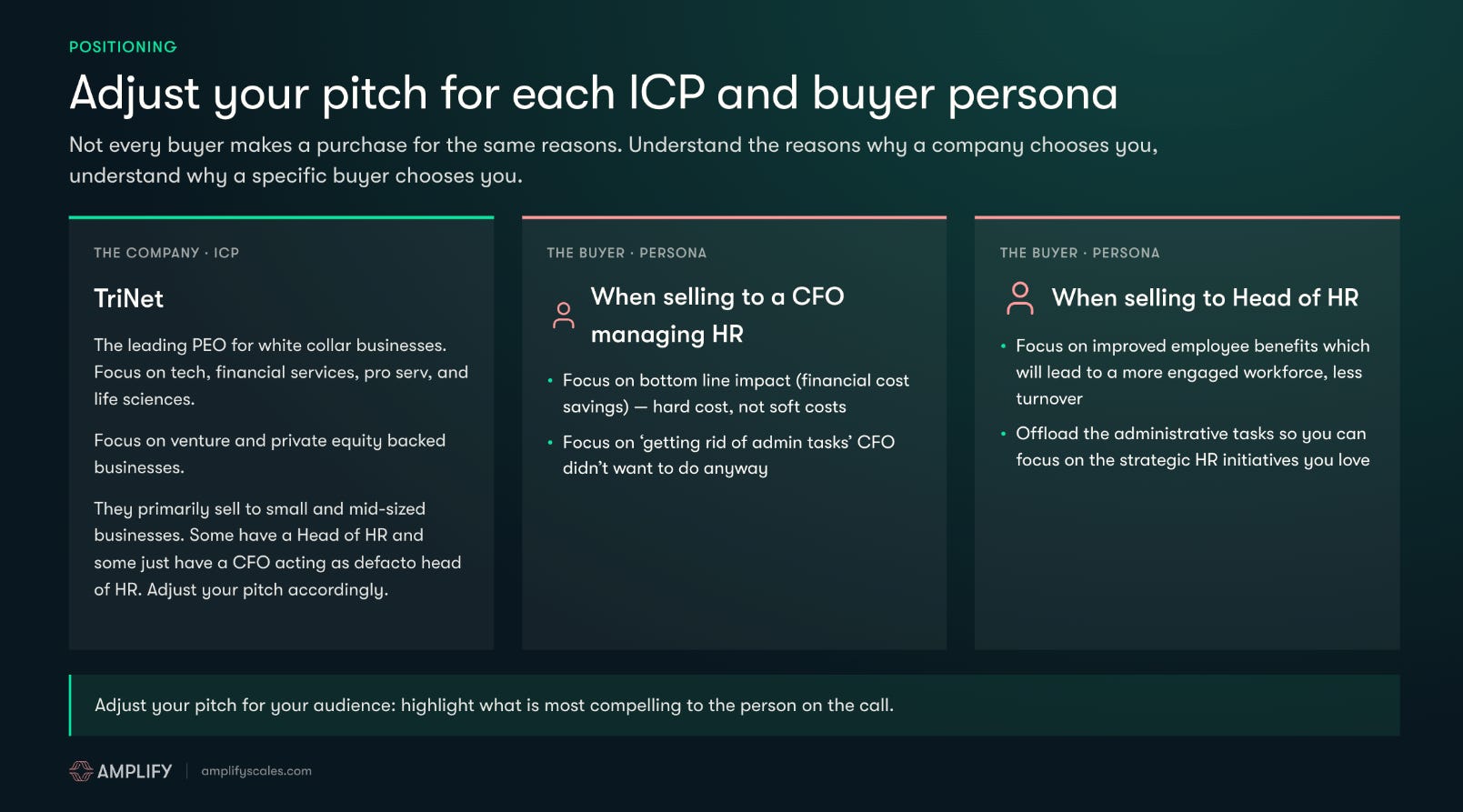
Selling to a CFO managing HR by default: lead with bottom-line impact — hard cost savings, not soft cost savings (“time”) — and with getting rid of the administrative work they never wanted in the first place. The emotional driver is relief.
Selling to a Head of HR: lead with better benefits driving a more engaged workforce and less turnover, and with offloading the administrative grind so they can spend time on the strategic HR work they actually care about - culture, professional development, etc. The emotional driver is ambition.
Same value, different framing, because the two people are motivated by and measured on different things. The CFO is protecting margins. The Head of HR is building a team and a culture.
This is what good buyer personas are for. Not demographics — decision criteria. What does this person get rewarded for, what are they afraid of, and which of your capabilities speaks to that?
Founder self-check
Run yourself through these honestly:
Can you name all four non-vendor alternatives your buyers are weighing you against — and do you have an argument ready for each?
Is your current positioning something you can prove today, or is it the company you’re planning to be in three years?
If you sell to more than one ICP, do you have a distinct argument for each — or one pitch you quietly hope covers both?
Does your pitch change based on who’s on the call? Does your rep’s pitch change, or just yours?
When you lost your last five deals, do you know which alternative actually won?
Where to start
Write a one-page positioning doc for each ICP you sell to. One page. Not a deck, not a brand exercise.
On it: the alternatives that specific segment is weighing (including doing nothing, building, and hiring), what’s genuinely unique about you versus those alternatives, the value that enables, and the one sentence you’d open a first call with.
Then add a short block per persona underneath — two or three bullets on what that role cares about most and what to lead with.
Good. Do it from memory for your primary ICP. You already know most of it; it’s just never been written down. An hour, honestly.
Better. Validate it with five customer conversations before you commit. Ask what else they considered, what nearly stopped them from buying, and who else had to say yes. You’ll be wrong about at least one thing, and it’s much cheaper to find out now.
Best. Turn it into sales enablement. Build the ICP and persona variants into your outbound sequences, sales assets, discovery questions, and your follow-up templates so the right argument gets made whether or not you’re in the room. This is one of the assets you build before you hire an AE, not after.
And if you do this exercise and land somewhere surprising — I’d love to hear about it.
I’m rooting for you!
With love and gratitude -

If you want to learn more about working with me directly…
For B2B startups, we serve as your Fractional GTM executive or engineer. Learn more about -
When you’re ready, let’s connect to discuss your specific growth goals and challenges.
Subscribe for weekly education, ideas, and frameworks
In this newsletter I share the exact tips, playbooks, and GTM multi-vitamins I’ve used to help 30+ B2B startups scale their revenue 150-590% YoY.