

Hi friends - Happy Sunday! Welcome to Part II of our GTM strategy series.
In Part I, we covered what GTM strategy actually means, the four sources of revenue, and three principles for building a strong strategy. I also shared some examples from my client work that illustrate why you can’t just copy someone else’s playbook.
This week, we’re getting into the how — a practical framework for evaluating which GTM tactics actually deserve your time, money, and energy based on your specific situation.
A quick caveat before we dive in: this is one of the hardest topics to give general advice on. But I’m gonna try anyway because — I like hard things.
Which tactics will work for you is incredibly specific to your company — your ICP, your buyer personas, your competitive landscape, your budget, your stage.
What I’m sharing here is my best effort at a general framework based on patterns I’ve seen across 30+ startups (and troves of data that I’ve read on the topic over the years). But take everything with a grain of salt and always filter it through the lens of your own unique situation.
Two categories of GTM investment
At the highest level, I think about GTM tactical investments in two categories:
The non-negotiables — tactics that almost every company should invest in regardless of who you’re selling to or how early you are
Everything else — the tactics that vary based on your ICP, stage, and resources
The first category is straightforward. The second is where the real strategic decisions live — and where most founders either spread themselves too thin or pick the wrong things.
Let’s break each one down.
The non-negotiables
Organic growth
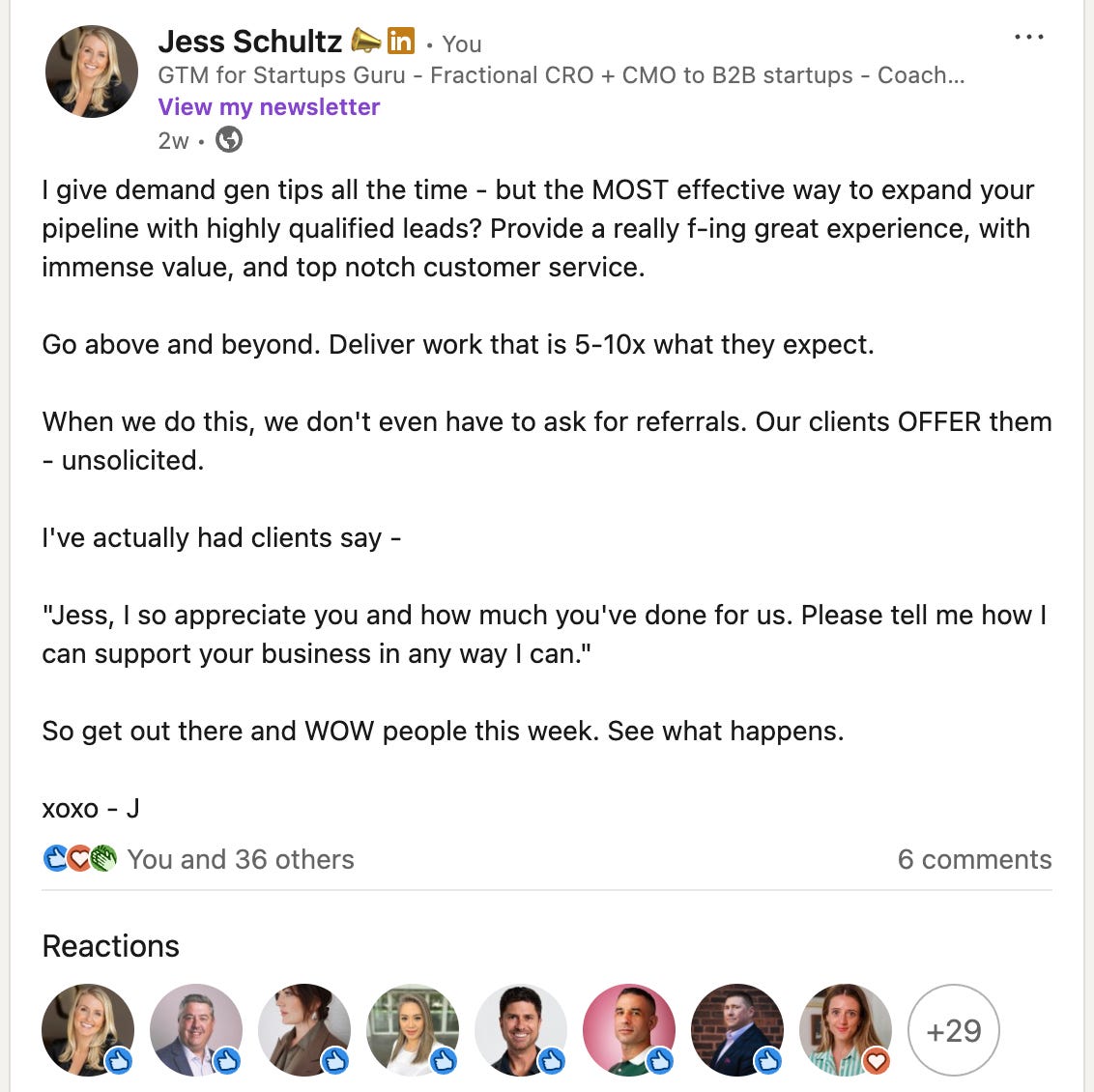
Your existing customers are your lowest-hanging fruit. They already know you, trust you, and have presumably seen value in your solution. That makes them your lowest-effort, highest-quality source of pipeline.
Organic growth should always be top of mind. That means requesting referrals from your customers, incentivizing them to make those referrals, providing a kickass customer experience, and making sure you’re on top of renewals and upsells.
This isn’t a “nice to have” — it should be a staple of every GTM strategy.
Your current customers should also become part of your marketing strategy. Their faces and voices are your best marketing.
I’ve written about the full-funnel power of customer reviews and case studies, if you want to go deeper there. I also plan to cover customer success tactics in greater detail this year — so stay tuned.
Your website
Your website is your only 24/7 salesperson.
Every single GTM tactic you deploy is eventually going to lead people back to it. Paid search leads people to your website. PR leads people to your website. Cold outreach — when someone gets a cold email that piques their interest, the first thing they do is go check out your website.
Hell, even REFERRALS lead people to your website. When someone makes a recommendation to me in passing/verbally, the very next thing I do before I opt into that referral is…check out their website.
That’s why investing in your website is non-negotiable for everyone.
It doesn’t matter what stage you’re at, who your ICP is, or what your budget looks like. If your website doesn’t clearly communicate who you are, what you do, for who, and why someone should care, every other tactic you invest in will underperform.
Founder brand
There’s significant research that suggests consumers and businesses alike are much more likely to purchase a product or service if the CEO, founder, or executive team is active in the market and people feel like they know that person. It’s the humanizing factor, and it drives results.
This applies across the board — B2C, B2B, startups, even enterprises. Nine times out of ten, elevating your personal brand is a tactic that should be in your GTM strategy.
You can build your founder or executive brand through social media (more on that below) and through PR — think guest podcast appearances, securing speaking opportunities, or panel spots at conferences. It doesn’t require a big budget. It requires consistency and a willingness to put yourself out there.
Funny…I’d been giving this advice for years before I realized someone wrote a whole book on it, too —> check out Founder Brand if you still aren’t convinced.
Everything else…how to identify which other tactics to invest in
This is where it gets interesting — and where most generic GTM advice falls apart.
Start with your ICP and buyer persona
Before you evaluate any of the tactics below, you need to know who you’re trying to reach. This is exactly why defining your ICP and buyer personas is so critical. You can’t confidently determine which channels and tactics will work until you deeply understand who your target audience is, where they spend their time, and how they make purchasing decisions.
If you haven’t done that work yet, go back and do it first. Everything below depends on it.
Talk to your customers (and your team)
The single most effective way to figure out which tactics will work for your business is to talk to your customers and prospective customers. Ask them directly things like:
How do you find out about new products or solutions?
Who do you turn to for advice and recommendations?
Where do you consume industry information?
When you were evaluating us, what did that process look like?
Additionally, consider conducting a customer journey mapping exercise with your entire customer-facing team. There are people across your organization — sales, customer success, marketing, even product — who have institutional knowledge about how your prospective customers discover and vet new solutions.
A structured exercise to surface all of that knowledge will pay off tenfold and help you avoid investing in tactics that don’t match how your buyers actually behave.
Pick 3-5, not all of them
Here’s the critical part: as a startup, you should only pick 3-5 of these tactics to invest the majority of your time and energy in. Any more than that and you’re going to spread yourself too thin.
As you evaluate all of the options below, disqualify first, and then stack rank which ones you think will drive the most impact for your business and invest in your top choices. Master those before expanding.
As you grow and have more resources — more people, more budget — you can layer in additional tactics. Enterprise-level companies like Salesforce and HubSpot do all of these things now. But they didn’t start that way, and you shouldn’t either.
Evaluating your options
With your ICP defined and your customer research in hand, here’s how to think about each major tactic. The easiest approach is often to disqualify tactics first to narrow down your options. Then stack rank what’s left.
Paid search
Paid search is generally a viable tactic if one or more of these three things are true: your average contract value is relatively small (think sub-$1,000), there’s actual search volume for your keywords, or you can a very specific buyer persona through paid social.
Note: Paid ad targeting options vary drastically for search engines vs social and even across social platforms.
Why the ACV threshold? People don’t spend a ton of time deliberating on purchases under $1,000. They search, they find you, they buy — the decision cycle is short, and paid search may pay off pretty quickly.
But the more expensive your product is, the less likely someone is going to just buy it with a credit card after clicking an ad. It’s going to go through a more rigorous sales process, which means paid search alone is less likely to generate immediate returns.
That’s a broad strokes way of thinking about it — it’s more nuanced than just this. I’ve published an entire series on paid ads with my friend Peter Guba that goes much deeper: when to introduce paid ads, how to determine the best channels, and how to develop your budget.
Content marketing and SEO
Whether content marketing and SEO make sense for you really depends on how your particular prospect evaluates their options.
In Part I, I shared the example of a client selling FX and treasury infrastructure to financial services companies. There was virtually no search volume for their keywords. Their prospective customers turned to peers and trusted advisors for referrals — they didn’t go to Google. SEO was never going to be their fast path to growth.
This is where those customer interviews I mentioned earlier are going to pay off. If your customers tell you they turn to Google when evaluating new solutions, and you can confirm that search volume actually exists for your keywords, then SEO may be a strong strategy for you.
To validate this, you can use third-party tools like Semrush to check keyword volume and to look at where your competitors are getting their traffic from — whether that’s organic search (SEO), AI-generated search (AEO), or paid ads. That data is accessible to the public (some behind paywalls, some free), though you may want to work with a marketing expert to interpret it. It can be hard for someone who’s not a marketer to just jump into Semrush and dissect the data.
If you know you have one or two bigger competitors that are pretty active online, Semrush or a similar tool will help you understand how they’re getting their traffic. That competitive intelligence alone can help you decide whether SEO is worth your investment.
One important caveat: you may still create content even if SEO isn’t part of your core strategy. Content serves purposes beyond search rankings — it can be used for sales enablement, nurturing prospects, supporting customer onboarding, and more. SEO is not the only reason to create content.
I’ve written more about this in my sales enablement article.
Social media
Organic social media is generally a great tactic for almost any company. It’s a relatively inexpensive way to build your brand and distribute your marketing content.
The platform you choose is going to depend on your ICP. Different platforms have different demographics, so depending on whether you’re selling primarily to women or men, consumer products or B2B, you might choose Instagram over LinkedIn, or vice versa. The specific platform may vary, but almost always, a social media presence is a solid tactic and a distribution channel for all of your other marketing efforts.
PR
PR is another tactic that’s great for most companies. The key is to start scrappy. There are low-cost PR tactics that can move the needle without a big investment — things like pitching yourself for podcast appearances, writing guest articles, or leveraging your own network for introductions to journalists.
Once you have more capital and a bigger budget, it’s almost always true that investing further in PR will help elevate your brand. But you don’t need to wait until you can afford a $10k/month agency to get started. I’ve put together a PR starter kit for startups with a practical, low-cost way to get going.
Conferences and events
Some form of conferences and events should be incorporated into almost every GTM strategy. But you want to be highly selective about which ones you attend to maximize your ROI. And by ROI — I’m not just referring to the financial cost — I’m also referring to your most sacred commodity — your time.
I would prioritize conferences where you can secure a speaking opportunity, host a roundtable, or an intimate dinner — something where you can connect with your buyers one-to-one. This is very different from just showing up and walking around a convention center with a thousand other people, or paying for a booth.
Paying for a booth is almost never the most economical way for a startup to build pipeline. But attending the right niche conferences? That can make a huge difference. In Part I, I gave the example of the company selling software to veterinarians that generated 90% of their pipeline from niche veterinary conferences. For some ICPs, conferences are a massive part of the strategy.
Your customer interviews and journey mapping exercise will help you determine how much of your strategy should hinge on conferences and which ones are worth your time.
You can also host your own events — executive dinners, roundtables, happy hours. Self-hosted events are almost always high ROI because you control the audience that’s invited, the conversation, and the budget. I highly recommend almost every company invest in hosting their own events. I’ve written more about this in my IRL events guide.
Cold outbound
As I covered in Part I, cold outbound is the lowest-converting channel overall and tends to produce the lowest-quality leads. But it may be more or less effective for you based on who you’re reaching out to and the price of your product.
If you’re selling a less expensive, more commoditized product, you may have decent success with cold outreach and conversions. But the more expensive your product is, the less likely that cold outreach will be highly effective. If you’re reaching out cold to enterprises about a six-figure deal, the odds are not in your favor.
Certain personas also tend to be more receptive to cold outbound than others. Studies have found that HR, sales, and marketing buyers are more likely to respond to cold outreach than technical buyers like CTOs or heads of data science. If your buyer persona is in one of those more receptive categories, outbound might have a role in your strategy. If you’re selling to deeply technical buyers, temper your expectations.
For more on outbound tactics, check out The LinkedIn Outbound Advantage.
Partnerships and ecosystems
Partnerships and ecosystem development are also almost always good tactics, but in some cases, they’re essential to your GTM strategy.
For certain enterprise products, the buyer may always use a consultant to verify the purchase. If that’s the case, then partnering with Big Four consulting firms or other influential advisors in your space isn’t just “nice to have” — it’s critical, because those firms are always going to be involved in the buying decision.
How central partnerships need to be in your strategy really varies company to company. It comes down to understanding your buyer’s decision-making process: who else is involved in the purchase? If the answer is “consultants, advisors, or complementary vendors are always in the room,” then partnerships need to be a top priority.
I’ve written a whole series on this topic, starting with Nearbound 101: Types of B2B Partnerships.
Account-based marketing (ABM)
If you’re selling into enterprises, account-based marketing is almost always a good idea. ABM flips the traditional marketing funnel — instead of casting a wide net, you identify specific high-value accounts and tailor your outreach and marketing efforts directly to them.
For enterprise-level sales where deal sizes are large and buying committees are complex, ABM helps you focus your limited resources on the accounts that matter most. My good friend Corrina Owens has written a deeper dive on this in ABM 101.
Putting it all together
Here’s the short version:
Do these no matter what: Invest in organic growth, your website, and your founder brand. These are your non-negotiables.
Then choose 3-5 additional tactics based on your ICP, your customer research, and your stage. Stack rank them by expected impact and go deep on your top choices.
Don’t try to do everything at once. Salesforce and HubSpot do all of these things. You’re not Salesforce and HubSpot — yet. Master a few tactics first, then expand as you grow.
And remember — the best way to know what will work for your business is to actually ask your customers and prospects. The frameworks and guidance above can help you narrow things down, but nothing replaces firsthand insight into how your buyers discover, evaluate, and purchase solutions like yours.
See ya next week.
With love and gratitude -

If you want to learn more about working with me directly…
For B2B startups I serve as a Fractional GTM executive or advisor. Learn more about-
When you’re ready, let’s connect to discuss your specific growth goals and challenges.
Subscribe for weekly education, ideas, and frameworks
In this newsletter I share the exact tips, playbooks, and GTM multi-vitamins I’ve used to help 30+ B2B startups scale their revenue 150-590% YoY.