

Hi friends - Happy Sunday! For the next few weeks, we’re going to cover all things strategy.
Go-to-market success really comes down to two things: your strategy AND your execution.
“GTM strategy” is one of those terms that gets thrown around constantly but means different things to different people. Some think it’s just about picking marketing channels. Others conflate it with a product launch plan.
I’ll share how I define and approach it tactically.
What GTM strategy actually means
To develop your go-to-market strategy, you need to answer two foundational questions first:
Who are we targeting? This means defining your ICP (ideal customer profile) and buyer personas with specificity.
How are we positioning ourselves as unique and differentiated to that audience?
Only after you’ve confirmed those two things do you move on to the tactical question:
What channels and tactics make the most sense to engage and convert that audience?
Getting this order wrong is one of the most common mistakes I see founders make.
They jump straight to “should we try LinkedIn ads?” before they’ve nailed down who they’re actually trying to reach and why those people should care.
The four sources of revenue
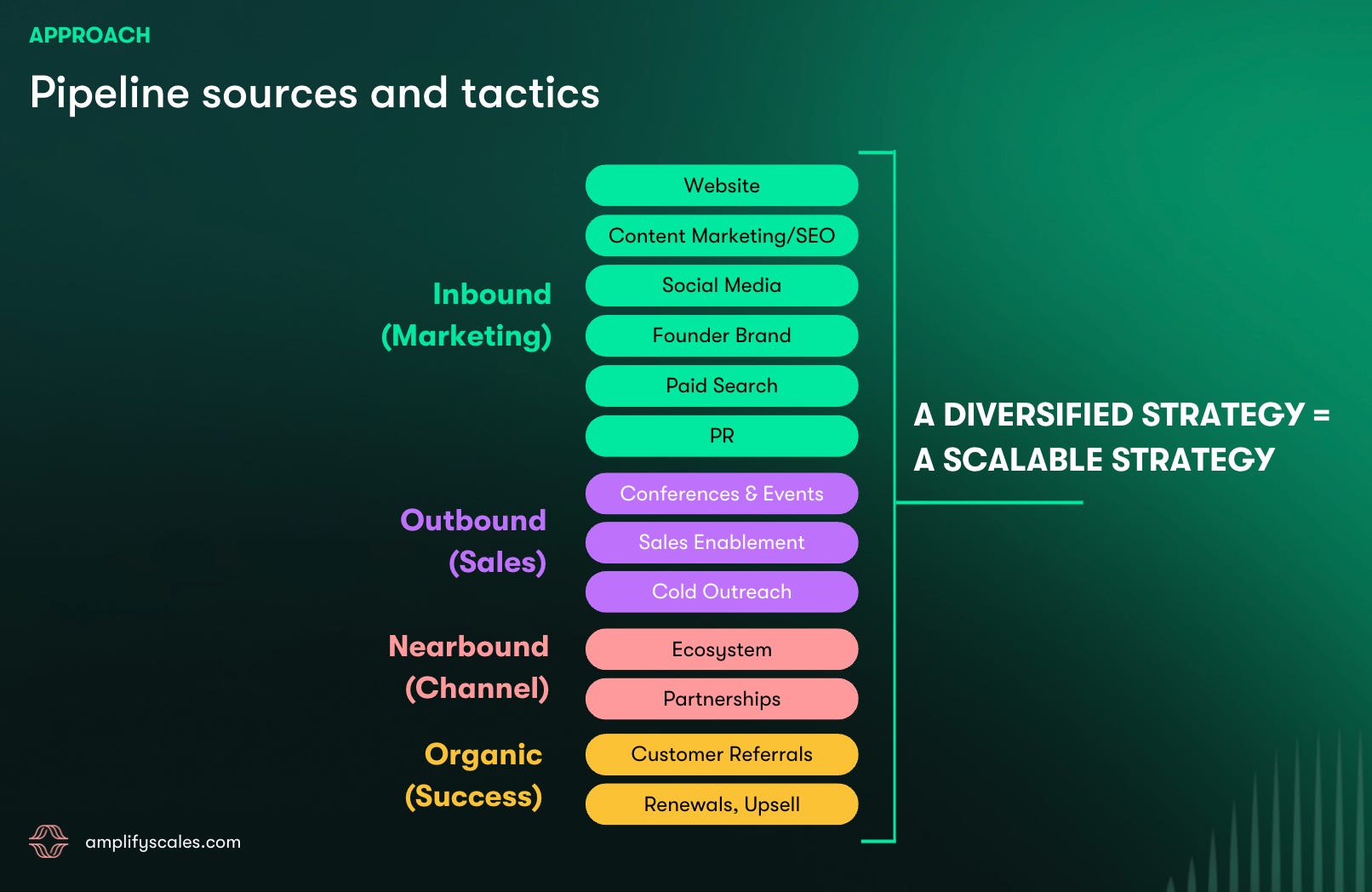
Here’s the thing—at the highest level—there are really only four sources of revenue for any company:
Inbound – Interest generated as a result of marketing efforts
Outbound – Interest generated through proactive sales efforts
Nearbound/Channel – Pipeline from partnerships and ecosystem relationships
Organic/Existing Customers – Renewals, upsells, and referrals
That’s it. Every tactic you’ll ever use falls into one of these four buckets.
And within each bucket, there’s a finite set of tactics available to you:
Three principles for building a strong GTM strategy
1. Diversify your efforts
Don’t invest solely in one source or tactic.
There are always variables changing outside your control—LinkedIn’s algorithm changes, Google updates its search ranking, a key partnership falls through, conference attendance drops.
Also consider the lead quality by source.
Not all pipeline is created equal in terms of effort or quality:
Existing customers are your lowest-hanging fruit (lowest effort, highest quality). They already know you, trust you, and have presumably seen value in your solution.
For net-new logos:
Inbound leads are the highest quality, but they take the most time and effort to develop.
Partnership and channel leads are your second-best quality source—they come with built-in trust from the referral.
Outbound motions are the easiest to get going…but also the lowest quality. Warm outbound motions using triggers like recent news or technographics performs better than pure cold, but as a category it’s still the lowest conversion (~1%) and quality—relatively speaking.
The smart play? Invest in a mix of short-term, faster tactics while building the groundwork for higher-quality, longer-term sustainability.

2. Pick 3-5 tactics to focus 80-90% of your time and energy on
Don’t spread yourself too thin. Early-stage companies have limited resources—time, budget, people. Trying to do everything means doing nothing well.
Choose 3-5 tactics where you can genuinely invest the majority of your time and energy. Master those before expanding.
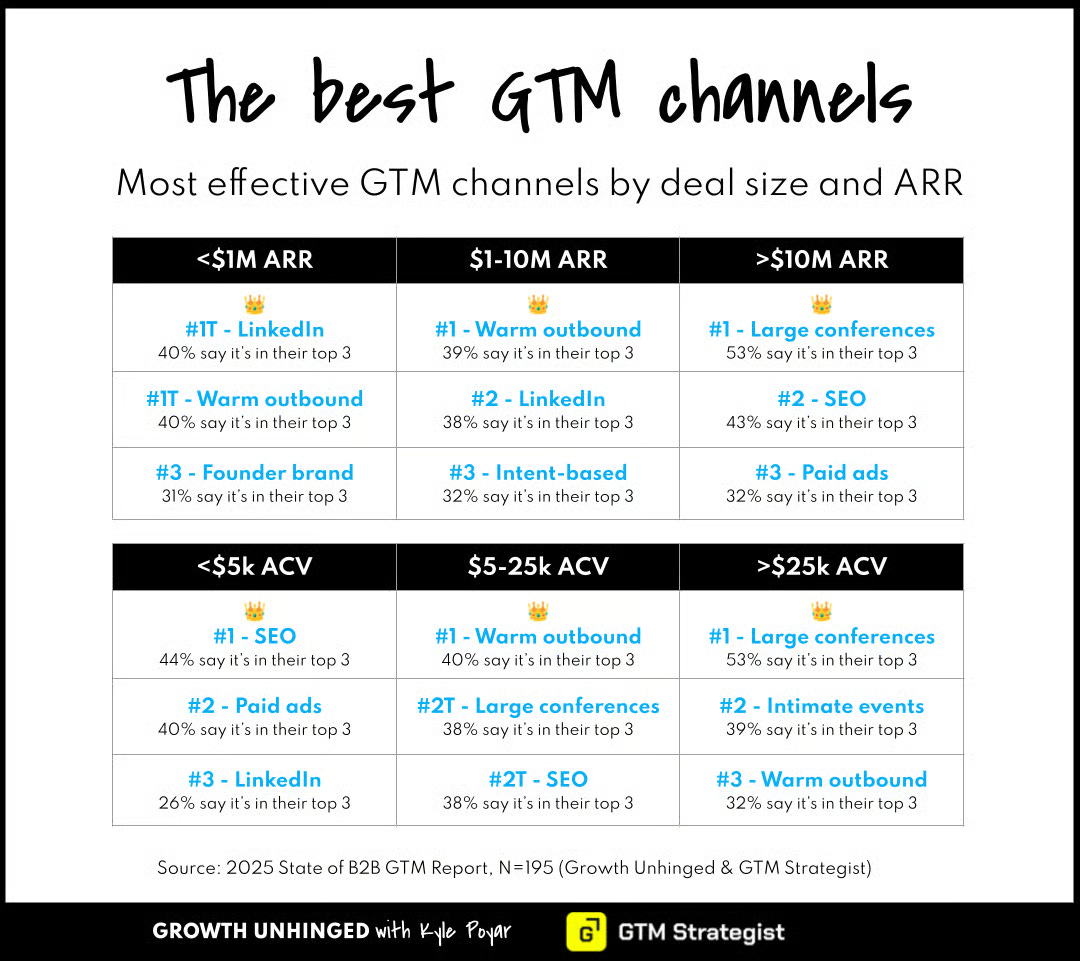
This is a great relatively recent resource that details what is working best right now for various ACVs, maturities, etc.
Note: This is generalized data for B2B software—not industry or ICP specific.
3. Consider what will actually work for your ICP
This is where most generic GTM advice falls apart. What works for your target audience depends entirely on who they are:
Where do they consume information?
Who do they trust?
Where do they “hang out”?
When and where are they most engaged to absorb new information?
The answers can vary dramatically by audience.
Why “best practices” don’t always apply
Let me share a few examples from my client work that illustrate why you can’t just copy anyone else’s GTM playbook without fine-tuning it for your specific fact set:
Technical buyers don’t respond well to cold outbound. CTOs, heads of data science, and engineering leaders are statistically the least likely to respond to cold outreach. Sales, marketing, and HR buyers are the most responsive (relatively speaking). But even then—remember, cold outbound averages around a 1% conversion rate.
Some audiences aren’t on traditional digital channels. I worked with a company selling software to veterinarians. They generated 90% of their pipeline from niche veterinary conferences. Why? Vets spend their days with animals—not scrolling LinkedIn or searching Google. But when they attend industry conferences, they’re highly engaged and actively looking for solutions.
Some markets have no search volume. I worked with a company selling FX and treasury infrastructure to financial services companies. There was virtually no Google search volume for their keywords. SEO wasn’t going to be their path to growth. This audience is most likely to turn to their peers or trusted advisors for referrals.
New categories face a search volume challenge. I’ve worked with several companies creating first-of-their-kind solutions aka creating new categories. Keyword search can be challenging when no one is searching for your category yet. People search for “CRM for startups” or “HubSpot alternatives” because they know CRMs exist. If you’re creating something entirely new, the SEO playbook may not work.
So how do you figure out which tactics are right for you?
That’s exactly what I’ll cover next week—a framework for evaluating which GTM tactics deserve your investment based on your specific ICP, stage, and resources.
See ya there.
With love and gratitude -

If you want to learn more about working with me directly…
For B2B startups I serve as a Fractional GTM executive or advisor. Learn more about-
When you’re ready, let’s connect to discuss your specific growth goals and challenges.
Subscribe for weekly education, ideas, and frameworks
In this newsletter I share the exact tips, playbooks, and GTM multi-vitamins I’ve used to help 30+ B2B startups scale their revenue 150-590% YoY.
Thanks for reading GTM for Startups by Jess! This post is public so feel free to share it.