

Hi friends — I’m a big fan of metaphors, and one I use regularly to describe the best way to build your pipeline is this: it’s very similar to getting healthy or in shape.
You can’t do it in a weekend. You can’t hit the gym once or eat clean for five days, and call yourself healthy. Fitness is a hundred small, boring, consistent reps — and the results only show up months after you start showing up.
Building a healthy pipeline works exactly the same way. There are a handful of investments that won’t pay off this week, this month, or maybe even this quarter — but they compound quietly until one day they’re the whole reason you’re still growing. And because they don’t scratch the instant-gratification itch, founders often keep pushing them off.
Across the 40+ startups I’ve worked with intimately — and the 1,000+ founders I’ve taught along the way — the same three deferrals show up again and again. None of them feel like mistakes in the moment. That’s exactly what makes them so expensive.
The 3 GTM foundations founders build too late
#1: Waiting too long to invest in marketing
There are really only four sources of pipeline at the 50k ft view: inbound (what your marketing creates), outbound, nearbound (partnerships), and your existing customers (organic growth). And not all pipeline is created equal in terms of effort or quality.
Your existing customers and their referrals are the lowest-hanging fruit — lowest effort to activate and highest relative quality.
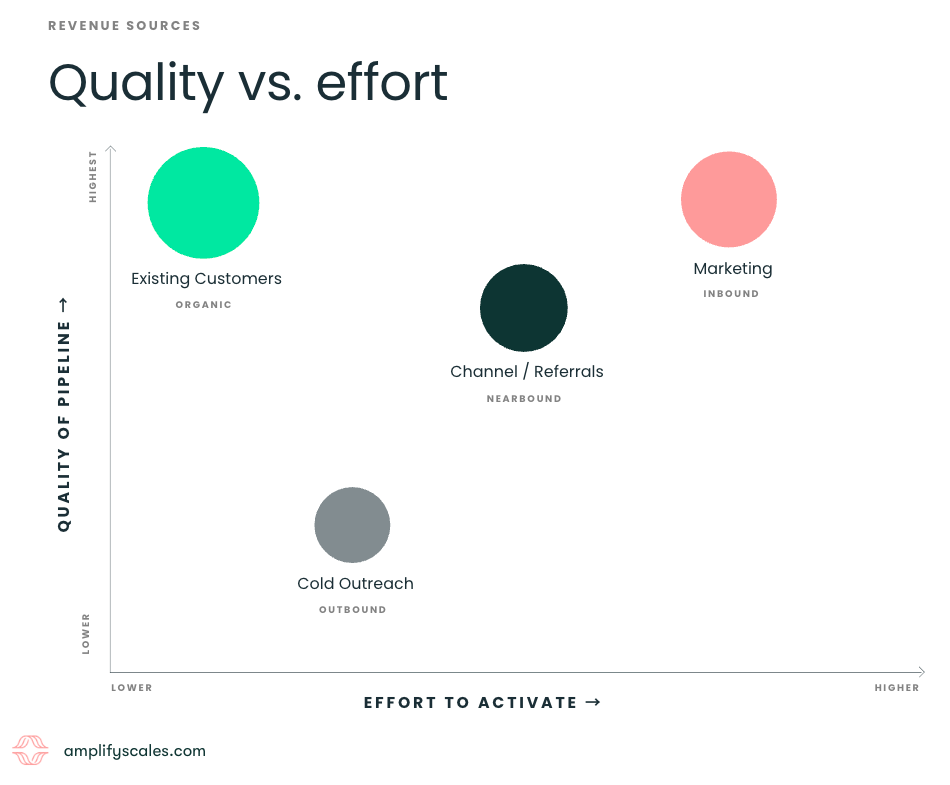
Outbound is the easiest to spin up, but it’s the lowest-quality source (cold outbound converts around 1%), and it’s getting harder every year — it now takes roughly 5x the touchpoints it did five years ago to land a single opportunity. Not to mention how much harder email deliverability has gotten. It does not reliably get you a meeting this week the way it used to.
Inbound — the pipeline your marketing creates — is generally the highest-quality source of the four. But it’s also the one that takes the most time and effort to build. That’s the trap: the highest-quality pipeline is also the slowest to pay off, so founders keep pushing it to “later” and lean on the easier, faster sources instead.
Then one day those tap out, the line flattens, and it doesn’t feel like a ceiling — it feels like a cliff. And the thing that would’ve caught you — marketing — has a lag. PR, content, SEO, AEO, brand, an audience you can actually activate… none of it turns on like a faucet. Start the month you hit the cliff, and you’re looking at two or three quarters before it pays you back.
You needed to plant that tree a year ago.
Here’s the good news: investing in marketing early doesn’t mean you need to do the hardest, most expensive version of it. Start with the lowest-effort, highest-impact move — building an audience of your ideal customers through founder thought leadership (aka founder brand). Nurture that audience every week. Start simple and expand your efforts as budget and resources expand.
Marketing is how you attract people to you instead of chasing them. Mindshare earns you market share — and you build it one consistent rep at a time, not in a panic sprint.
#2: Not taking basic RevOps seriously (early enough)
This is the least glamorous item on the list, and the one that quietly makes everything else work.
I’m not talking about a fancy tech stack or a full-time RevOps hire – you may not need that yet. I’m talking about the basics: record your calls, log your emails to a CRM, and track your deals in real stages. That’s the starter kit — and a minimum viable stack runs under $500/month. It feels like overhead when it’s just you and a couple of reps closing on instinct, so founders skip it and promise to “clean it up later.”
The problem is that every future hire and every AI tool you adopt inherits this foundation — or inherits the lack of one. You can’t hand a new rep, or an AI, a knowledge base you never built. When the data isn’t there, onboarding drags, coaching is guesswork, forecasting is fiction, and every shiny AI tool you bolt on is running garbage in, garbage out.
And here’s what makes this worth doing today, not someday: this data pays off even while you’re still running a founder-led sales motion.
Once your calls, emails, and deal history are actually captured, you can hand them to Claude (or the AI of your choice) and turn it into your on-demand RevOps analyst and sales coach.
Ask it what your won deals have in common and what your lost deals share.
Ask it for the most common questions and objections that come up on your calls — then sharpen your pitch and build the answers right into your process.
You don’t need a RevOps hire, or even a full sales team, to get value. You just need the raw data. It’s still genuinely useful when it’s just you selling — and it becomes absolutely critical the moment you start scaling beyond founder-led.
This is not a one-and-done task, either. Your talk track, deal stages, CRM fields, and definitions will change as you learn what actually predicts a win or is useful for analysis. Start the habit now and refine it forever.
#3: Not preparing for GTM hires before you hire them
Founders hire a salesperson or a first marketer expecting them to fix growth — then act surprised when it doesn’t work. It’s not a fluke. 50–70% of startup sales hires fail, and a huge chunk of that traces back to the founder not being ready — not the hire being bad.
So before you start recruiting, put the foundation for success in place. Here’s the checklist I walk founders through before their first sales hire. Have 80% of that in place before they start and you increase their odds of success roughly 5x. It’s the same principle for a first marketing hire — they need your context, your customer data, and your story to have any shot at moving the needle.
And here’s the part founders miss: this isn’t a checklist you complete once and file away. It’s evergreen — same gym analogy. Your ICP sharpens, your positioning shifts, you win and lose new deals, your story grows. The list only stays useful if you keep it current. Update it as you learn, and every future hire ramps faster than the last.
Why does all this matter so much? Because hiring prematurely is one of the most expensive mistakes a founder can make. Bring someone on before you’re ready and, in roughly 90% of cases, you’re not buying incremental revenue — you’re just burning cash.
You pay a salary (plus ramp, tools, and your own management time) for months while they try to build the foundation you skipped. And in the rare case they figure it out anyway, it takes far longer than it should have for them to be successful. Lost time, lost momentum, lost runway.
And before you even decide who to hire, there are two questions about seniority and capacity that most founders skip entirely — but that’s a framework all its own. More on that next week. 👀
Founder self-check
Run yourself through these honestly:
If referrals and outbound dried up tomorrow, do I have anything compounding in the background — or would I be starting marketing from zero?
Are my calls recorded, my emails logged, and my deals tracked in real stages today — or am I still promising to “clean it up later”?
Before my last GTM hire, did I have an ICP, a comp plan, and a system for them to plug into — or did I expect them to build it?
If you flinched at any of those, I’d strongly encourage you to leverage the resources above to course correct. You’ll thank me later.
Where to start
You don’t need a big budget, a team, or a perfect system. You need to start the smallest sustainable version of each — this week:
Marketing: pick one channel and one cadence you can actually keep, and start now, while outbound and referrals are still working.
RevOps: turn on call recording and CRM email logging today. That’s it. Refine later.
Hiring prep: pick one item from the pre-hire checklist to tackle each week for the next 2-3 months.
Revenue growth comes from consistent reps, not a sprint
Good, better, best — just start. Marketing, RevOps, and hiring readiness are evergreen investments. None of them reward the shortcut, and all of them punish neglect. The founders who get this don’t work harder than the ones who don’t — they just started earlier and stayed consistent, so by the time growth got hard, the foundation was already there holding them up.
The best time to start was a year ago. The second best is today. 💪
P.S. Which of these three is the one you keep pushing off? Hit reply and tell me — I read every response.
With love and gratitude -

If you want to learn more about working with me directly…
For B2B startups, we serve as your Fractional GTM executive or engineer. Learn more about -
When you’re ready, let’s connect to discuss your specific growth goals and challenges.
Subscribe for weekly education, ideas, and frameworks
In this newsletter I share the exact tips, playbooks, and GTM multi-vitamins I’ve used to help 30+ B2B startups scale their revenue 150-590% YoY.