

Hi friends — A quick update before I dig into today’s topic! I launched a new offering for the super early stage companies (<$500k ARR) called a GTM Diagnostic. I designed it in collaboration with two accelerators and have run it with 8 founders now with great success. If you want to learn more - check out the details here.
This week we’re talking about case study APPROVALS!
Because what actually stops most startups from publishing isn’t the writing. I’ve covered how to write a case study and how to use AI to get it done in under an hour. You interview the customer. You write the thing. It’s good.
And then your champion sends it to marketing, or legal, or comms — and it goes into the void. Six weeks (or months) later you’re still following up, and you’ve quietly decided case studies aren’t worth the effort. But please know the juice is worth the squeeze and you should not give up.
Getting a case study approved is not impossible – even if your customer is a large enterprise. You just need the right framing and the right strategy. Let’s dig in.
How to get your case study approved (and what to do when you can’t)
First, let’s make the case about why the juice is worth the squeeze here -
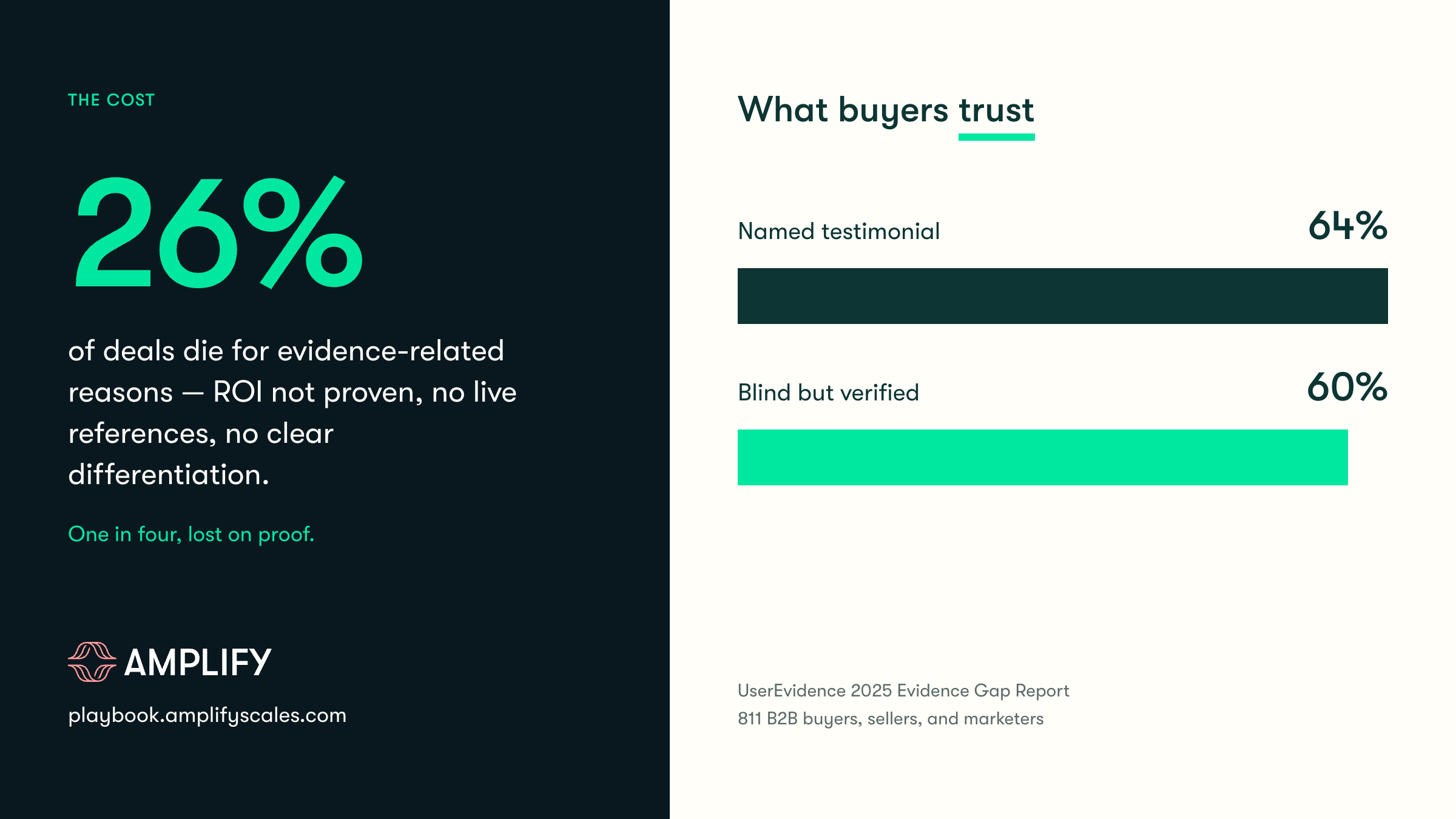
UserEvidence’s 2025 Evidence Gap Report surveyed 811 B2B buyers, sellers, and marketers, and a few numbers jumped out at me. First: 26% of deals die for evidence-related reasons — ROI not proven, no live references, no clear differentiation. That’s a quarter of your pipeline lost because the buyer couldn’t get the proof they needed. Second: named testimonials are the most trusted form of customer evidence at 64% — and blind but verified ones are right behind at 60%. Hold onto that second number, we’ll come back to it.
It’s not a demand problem – it’s a supply problem. 36% of marketers published two or fewer customer stories in the last six months. Most companies have three case studies, from two years ago, about an industry or use case that isn’t relevant to their active GTM strategy. Case studies are not a dying format — they just have a volume and relevance problem.
And the reason output stays that low is exactly what we’re talking about today. Kevin Lau, VP of Global Customer Marketing at Freshworks, put it perfectly in that same report:
“Most companies treat customer stories like one-off trophies, and the process is full of dependencies outside marketing’s control — customer approvals, legal reviews. That’s why the volume never gets there.”
I’ve got some tips to help you get over this mindset and past these hurdles.
My standard advice for case studies is: get three to start, then add at least one every quarter – forever. A story from a company that looks like your prospect, from this year, beats a gorgeous flagship case study from 2023 every single time.
And that cadence only works if approval isn’t a heroic one-off effort each time. Here’s the thing most of us underestimate: your champion has to spend political capital inside their own company to get you a yes, yet we often hand them a document that makes us look great and doesn’t properly arm them for that battle.
So let’s fix that. And let’s stop treating approval as binary.
Good, better, best
This is how I approach every case study ask now, and it’s changed my hit rate considerably. There isn’t one outcome — there are three, and all three are worth having.
Best: They let you name them and publish it publicly on your website. Full logo, full story, out in the world. This is the one that works hardest for you — it feeds sales, SEO, fundraising, and recruiting all at once. A true GTM multivitamin.
Better: They won’t let you post it publicly, but they’ll let you use it with their name on it in your one-to-one sales process. So you can’t put it on the site, but your AE can send it directly to a prospect who’s evaluating you. I’ve had Prudential agree to exactly this — no public post, but we could hand it to a prospect who needed to see that a company of that size had made the same bet. That logo does an enormous amount of work in a deal, even if Google never sees it.
Good: They won’t let you name them at all, but you can publish an anonymous case study. “A 2,000-person financial services firm.” You lose the logo, but you keep the story, the numbers, and the proof that the problem you solve is real and someone paid you to solve it.
Remember that number from up top? Named testimonials trust out at 64%, blind but verified at 60%. Four points. That’s the entire cost of losing the logo — as long as the story stays specific and verifiable. Buyers are looking for evidence that a company like theirs got a result, and “like theirs” is mostly about size, industry, and problem. Not name.
The reason I love framing it this way — beyond just protecting your downside — is that the good and better options give your champion somewhere to land other than no. When the only options are “yes, publish everything” or “no,” you get a lot of no. When you walk in with three doors, you almost always get through one of them.
Ask for best. Take better. Never walk away with nothing.
Four ways to raise your odds of getting to “best”
Make your customer the hero, not your product
This is the biggest one. Most case studies are written as: here was a broken company, and then our software saved them. Nobody wants to forward that to their VP of Comms.
Rewrite it so your customer is the one making smart, innovative, courageous calls. You’re the tool they chose. They’re the protagonists.
This matters even more when the underlying story isn’t flattering. Say a company hired you in the middle of a restructuring — that’s not a story anyone wants their logo on. But the story isn’t the restructuring. The story is that in a really hard moment, this leadership team went out of their way to protect their people and do it right. Same facts, completely different piece of content.
In most cases you can frame the whole thing positively without stretching the truth an inch. You’re not spinning. You’re choosing which true thing to lead with.
Give them credit as an innovator
If your customer shaped your product — gave you real feedback, pushed you on a feature, told you what was missing — say so in the case study. Name them as instrumental in the product’s direction.
People love being called an innovator. And it lands hardest exactly where you’d expect: at big, slow-moving companies where “I helped a startup build this” is a genuinely rare line to have on your internal résumé.
You’re not just being generous. You’re handing your champion something they want their leadership (or future employer) to read. That turns a favor you’re asking for into a favor you’re doing them — and it turns a polite supporter into someone actively pushing for approval on your behalf.
Find precedent and hand it to your champion
This is the tactic that most startups skip and it might be the highest-leverage one on the list.
Before you ask, go find every other public case study that company has already done with other vendors. If they’ve approved five in the last three years, the internal conversation shifts from “this will never get approved” to “we do this all the time”.
AI makes this genuinely a two-minute job now. Something like:
“Find me examples of [Company Name] appearing in public customer case studies, testimonials, or success stories published by their software vendors or service providers. Include the vendor name, the year, and a link to each one.”
Trust me — I ALWAYS find something — even for the Wells Fargo and Bank of Americas of the world.
Then send the list to your champion. Not as a gotcha — as ammunition. Something like: “Wanted to make this easy for you — here are a few other vendor case studies your team has approved, in case it’s helpful for the internal conversation.”
You’ve just done their homework for them and made them infinitely more confident sticking their neck out.
Ask at the moment of the win
Timing does more work here than persuasion. The right moment to ask is immediately after something measurable went well — a milestone hit, a number moved, a QBR where you reviewed the original goals and cleared them. Same principle that drives referral asks: the ask is easy when the value is fresh and undeniable.
Six months later, when the person who championed you has changed roles and the win has faded into “yeah, that’s just how we do things now,” you’re starting from zero.
Meanwhile: go collect reviews
Here’s the thing I tell every startup working on this. Even if you do all four of the above perfectly, case studies take a while. Legal queues, comms calendars, a champion who’s slammed. Weeks, sometimes months.
So don’t just wait. Run G2 and Capterra reviews in parallel.
Reviews clear far faster than case studies for one very specific reason: your customer can stay anonymous if they want to. On G2, a reviewer can choose to be fully named — or the review publishes as something like “VP at a financial services company with 5,000+ employees.” That completely sidesteps the approval problem, because there’s often nothing to approve. No logo usage, no legal review, no comms sign-off. Just one person sharing their honest experience.
And these aren’t low-trust reviews. Every G2 review is manually moderated by a human before it publishes, and reviewers have to sign in with a business email or LinkedIn account. If someone wants to prove they’re a current user, they can upload a screenshot of themselves logged into the product — and those screenshots are never shown publicly, only G2’s moderation team sees them. That review then carries a verified-user badge. Turnaround runs about three business days on G2 and up to five on Capterra for vendor-sourced reviews.
Days, not months. And buyers trust them precisely because of that verification — the same Evidence Gap Report found 66% of buyers trust third-party review sites more than they did a year ago. This isn’t a consolation prize. It’s a channel that’s actively gaining credibility while polished vendor content loses it.
So the play is: ask for the case study, and ask for the review at the same time. If the case study lands, wonderful — now you have both. If it stalls in legal for two months, you’re not sitting empty-handed. And if it dies entirely, the review becomes your second-best option instead of your only regret.
I’ve written more on why reviews punch so far above their weight — the full-funnel case for them and why they’re the highest-impact, lowest-effort evidence play at early stage.
When the answer is still no
Sometimes it’s a hard policy and there’s genuinely nothing your champion can do. Fine. You still have options:
Take the anonymized version and publish it. It still reduces buyer indecision, which is what case studies are actually for.
Ask for a smaller yes. A two-sentence quote you can use. Permission to use the logo on your site with no story attached. Or a verbal reference call for late-stage deals — a customer who’ll take a 20-minute call with a prospect is a referenceable customer, even if nothing about them ever gets published. Start a simple list of who’s willing to do what, and you’ve got the beginnings of a customer reference program without calling it one. And the review — if you didn’t already ask, ask now.
Founder self-check
Before your next case study ask, answer these honestly:
If my champion forwarded this document to their CMO right now, would it make them look good — or just make my product look good?
Have I checked whether this company has approved public case studies with other vendors before?
Am I asking at a moment when the win is fresh, or months after the fact?
Have I given them three options to choose from, or just one yes/no?
When did I last publish a new customer story — and does my most recent one look anything like the prospects I’m selling to today?
Where to start
Don’t overhaul anything. Pick your single happiest customer — the one you’d bet money would say yes — and run the full sequence on them once:
Write the story with them as the hero.
Add the innovator credit if it’s true.
Pull the precedent list with AI before you ask.
Ask for best, name better and good as options, and let them choose.
In the same conversation, ask for the G2 review — and mention they can stay anonymous.
Do it once, see which door they walk through, then repeat it with the next two customers. Three is your starting library. After that, one new story per quarter is the cadence that keeps your evidence recent and lets you match the story to the prospect instead of sending everyone the same 2023 flagship.
And whatever you get back — logo, anonymized, or a single good quote — put it in front of sales. Evidence that sits in a folder isn’t enablement.
P.S. Got a case study stuck in someone’s legal queue right now? Hit reply and tell me where it’s jammed — I’ve probably seen that exact objection.
With love and gratitude -

If you want to learn more about working with me directly…
For B2B startups, we serve as your Fractional GTM executive or engineer. Learn more about -
When you’re ready, let’s connect to discuss your specific growth goals and challenges.
Subscribe for weekly education, ideas, and frameworks
In this newsletter I share the exact tips, playbooks, and GTM multi-vitamins I’ve used to help 30+ B2B startups scale their revenue 150-590% YoY.