

Hi friends — Last week, I talked about the three most common GTM foundations founders build too late. Not properly preparing for your first GTM hires is one of the most expensive mistakes you can make — in roughly 90% of cases you’re just burning cash, not buying revenue.
This week, the promised follow-up: once you are prepared, how do you decide who to actually hire? Do you need an SDR, an AE or a VP of Sales? Different seniorities, solving for different gaps, operating with different autonomy, at different price points.
Because here’s the pattern I see across the 40+ startups I’ve worked with: founders start with the wrong question. They ask “What can I afford?” — and the answer to that question is almost always a junior hire. Cheaper salary, lower risk on paper, easier to say yes to. Six months later they’re back where they started, minus six months of salary and runway.
The affordability question isn’t wrong because budget doesn’t matter. It’s wrong because it skips the two more important pre-requisite questions. Let’s dig in.
Before you hire: the two questions that determine who (and how much) you need
One framework, two questions
One thing to note before we run through the framework: it’s function-agnostic. It works whether you’re hiring for marketing, sales, customer success, product, or ops — expertise and capacity are the variables every time, in any function.
But there is a prerequisite the framework can’t answer for you: which function are you actually trying to fill? “We need help with growth” isn’t a role. Is the constraint pipeline creation (marketing), deal conversion (sales), retention (CS), or the product itself? Scope the role before you shop for the person — misdiagnosing the function is how founders end up with a great salesperson trying to solve a marketing problem — it won’t end well.
Identify the function you’re hiring for first. Then ask yourself these two questions:
Question 1: Do you have the expertise in-house?
Not enthusiasm. Not adjacent experience. Real, reps-earned expertise in the function you’re hiring for.
If you’re a technical founder hiring your first marketer, be honest: could you coach them on positioning, channel selection, and what good looks like?
Question 2: Do you have the capacity to manage them?
And I mean genuinely manage — not a 30-minute weekly check-in, but the hours to guide, coach, review work, and course-correct. Capacity without expertise doesn’t count, and expertise without capacity doesn’t either. A junior hire needs someone who has both — the expertise to coach them AND the bandwidth to actually do it.
Here’s the relationship in one picture: the more expertise and capacity you have in-house, the more junior you can afford to go. The less you have, the more senior your hire needs to be — because senior people bring their own expertise and largely self-manage.
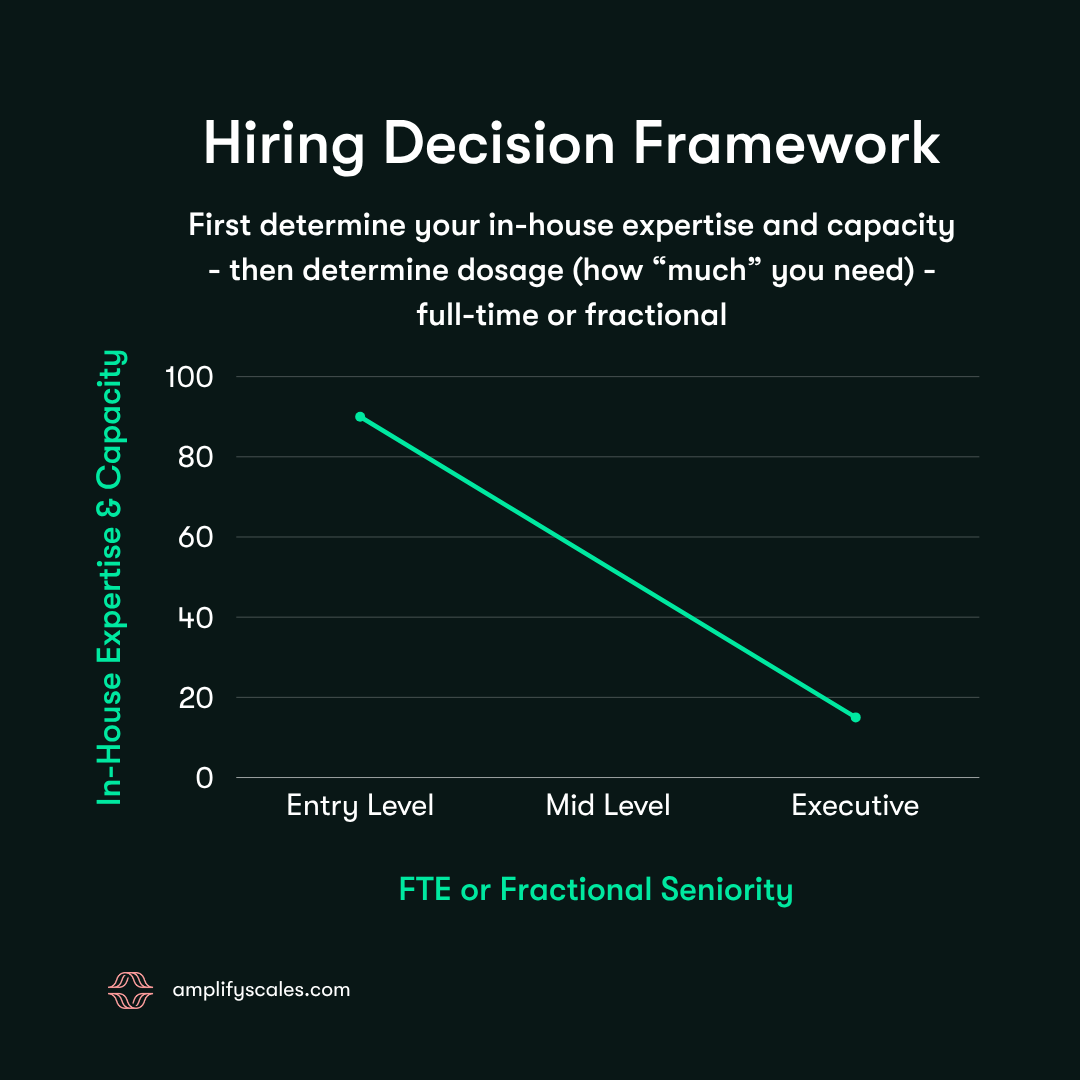
That downward slope is the framework. Junior hires aren’t cheaper — they’re cheaper salaries. Their true cost includes the senior time it takes to develop them. If you have that senior time and skill in-house, a junior hire can be your best-value move.
If you don’t, that “cheap” hire is quietly the most expensive person on your team — and this is exactly how SDR hires go wrong: the most entry-level, highest-churn role in sales, dropped into a company with no one equipped to train or manage them.
You know the old saying: “There is no free lunch”? That applies here, too. One way or the other — you are going to pay — either in cash or in time.
The four quadrants
Run the two questions together and you land in one of four spots:
Expertise ✅ + Capacity ✅ → You can hire junior and develop them. Cheapest hard dollar path — because you’re supplying the coaching yourself.
Expertise ✅ + Capacity 🚫 → You know what good looks like but have no hours to coach it. Hire senior enough to run with minimal direction.
Expertise 🚫 + Capacity ✅ → The sneaky-dangerous one. You have time to oversee but can’t teach the craft — so meetings happen, work gets reviewed, and nobody in the room knows if it’s any good. You need to buy the expertise.
Expertise 🚫 + Capacity 🚫 → You need someone who brings their own playbook and self-manages: a senior operator or a fractional executive.
Most failed first GTM hires I get called in to diagnose live in those bottom two quadrants: a founder hired junior while missing the expertise, the capacity, or both.
One important caveat in the other direction: match seniority to the gap — don’t maximize it. The slope argues for fit, not for always going senior. Don’t buy an executive to do all your execution work; a great senior operator with nothing strategic to own gets bored, expensive, and gone.
Then — and only then — ask how much of them you need
Seniority first. Dosage second.
Once you know the level of expertise the problem requires, the next question is: do you need that person 40 hours a week, or 10?
Early on, the honest answer for senior GTM expertise is often 10–15 focused hours — which is exactly the case for fractional talent. A fractional exec runs ~$10–15k/month against ~$32,500/month fully-loaded for a full-time VP, and brings pattern recognition from working across multiple companies at once. There are real qualitative trade-offs in both directions — dedicated focus vs. speed to value — and if you go the fractional route, here’s how to find and evaluate them.
The dosage question also unlocks a hybrid play I love for capital-efficient teams: a fractional senior + a full-time junior. The fractional exec supplies the expertise and the coaching; the junior supplies the hours and the execution. You’ve manufactured the top-left quadrant instead of waiting until you can afford it.
And whichever direction you go — junior, senior, or hybrid — define what great looks like before you interview. That’s your Ideal Candidate Profile, and for judging the person in front of you.
Founder self-check
Before your next GTM hire, answer these honestly:
Do I have real, reps-earned expertise in this function — or just opinions about it?
Could I give this person 5+ hours a week of genuine coaching for their first six months — and would that coaching actually be good?
Am I choosing this seniority level because it fits the gap… or because it fits the budget?
Have I separated the two decisions — what seniority I need, and how much of that person I need?
If the first two answers are “no,” the cheap hire is the expensive one.
Where to start
Write down the function you’re hiring for, then score yourself honestly: expertise (yes/no) and capacity (yes/no). Let the quadrant tell you the seniority you need.
Then ask the dosage question: how many hours a week does this problem actually need? That’s your fractional vs. full-time answer.
Draft the Ideal Candidate Profile before you post the role — not after the first interview.
Good hiring isn’t only about finding great people. It’s about being honest about what you can supply AND the total cost of the decision – either way.
P.S. Which quadrant are you in right now for the role you’re thinking about? Hit reply and tell me — I’ll tell you what I’d do.
With love and gratitude -

If you want to learn more about working with me directly…
For B2B startups, we serve as your Fractional GTM executive or engineer. Learn more about -
When you’re ready, let’s connect to discuss your specific growth goals and challenges.
Subscribe for weekly education, ideas, and frameworks
In this newsletter I share the exact tips, playbooks, and GTM multi-vitamins I’ve used to help 30+ B2B startups scale their revenue 150-590% YoY.