

I first wrote this original piece almost two years ago in 2024. A lot of the original advice still holds, but there are a few important updates to make it stronger and relevant for 2026.
This is the first article of a 4-part series on thought leadership (the full inventory is linked at the bottom).
In 2024, I told you to fix your LinkedIn profile because humans were looking at it. That’s still true. What’s new is that your profile is now also being read by machines that decide whether those humans ever find you at all.
Same first step (expanded), and even bigger impact.
The case for investing in founder brand and why optimizing your profile is the first step
The very best thing you can do for your pipeline AND your company is to develop your personal brand through thought leadership. Full stop.
And I know many of you are thinking...’Ugh, but I hate making it all about me. I don’t like the spotlight. And I don’t have the time.” I’ve heard it over and over from founders and other executives. I say this with love...get. over. it.
I had all of the same thoughts myself my first year in business. But then I kept hearing how important (and impactful) it was...and I got curious. I read a couple of books, and convinced myself to try it.
I made the time, and I committed to a year ‘experiment’.
And many of you know I’ve been quite active on social media the last several years, but funny enough, I was just like you until 2023.
That investment has paid off 10x.
It has amplified all of my other marketing and sales efforts (pun intended 😅). And beyond building a pipeline, it also attracted potential investors, and continues to attract top talent to submit their resume, even when I am not hiring. Literally every week I get a sales lead, a talent lead, or both.
Why is this so effective?
People buy from people. I’m sure you’ve heard that before, because it’s true. When you share your thoughts and ideas, people get to know you. And when they know you, and like you, they trust you. When they like you and trust you…they buy from you.
For startups, your company doesn’t yet have the brand recognition of Amazon or Salesforce. You may not have many clients yet. But 9/10, YOU the founder has a brand, an impressive history, a cool origin story, a reason why people should like and trust you. You have a brand - you just need to share it.
Founder thought leadership vs founder brand
Sometimes we use these terms interchangeably, but they are different – related, but different.
Your founder thought leadership is what you publish. The posts, the point of view, the thing you’re willing to say out loud that your competitors aren’t. It’s an activity. You should do it.
Your founder brand is what you’re known for. And it isn’t a page you build once and check off. It’s a living thing you’re influencing every single day by how and where you show up — your profile, your posts, your comments, the rooms you’re in, what your customers repeat about you when you’re not there, and what comes back when someone types your name into ChatGPT.
Thought leadership is one of the highest-leverage inputs into that brand and digital footprint.
So let’s say a founder decides to get serious, commits to posting on LinkedIn 3 times a week, and does it. Great!
But then sometimes, every one of those posts sends someone back to a profile that hasn’t been updated in three years, that describes a company they’ve since pivoted, with a Featured section full of stuff that was interesting in 2023 and no obvious next step.
They’re doing the hardest part — showing up with a POV — and quietly losing profile visitors to inaction because their profile isn’t optimized.
You’re not building nothing in that scenario. You’re building something, just not getting the impact you expected.
So the first step in the thought leadership playbook is: optimize your profile.
What changed since I first wrote this
AI has changed things, specifically, AEO.
Meltwater analyzed 9.5 million AI citations across 16 B2B categories and found LinkedIn is the #2 most-cited source by AI models, behind only YouTube. Profound’s analysis of 1.4 million citations put LinkedIn at #1 for professional queries across all six major AI platforms.
Different datasets, different query sets, slightly different rankings — same conclusion: when someone asks an AI a professional question, LinkedIn is one of the first places it looks. In the same Meltwater research, 6sense found 94% of B2B buyers now use LLMs somewhere in their buying process.
Sit with that for a second. Your buyer is asking an AI assistant who they should talk to, and LinkedIn is one of the primary places that assistant is getting its answer.
Keep it in proportion, though — same caveat I gave you in AEO 101. AI referral traffic is still a small slice of total volume, roughly 1 in 100 visitors. What makes it worth your attention is that the slice converts dramatically better than organic search, and it’s growing fast.
Two more findings from that research are worth your time.
First, 75% of those citations came from individual creators, not company pages. Not your company page. You.
Second, and this is the one I’d underline, the most-cited LinkedIn creators weren’t necessarily the ones with the biggest following. Many had low or medium audiences and engagement. What they had was deep domain credibility. LLMs are shifting from the social graph to the knowledge graph, prioritizing information density over follower count.
If you’ve been avoiding this because you assumed you’d need 50,000 followers before it counted for anything, that assumption is looking increasingly wrong.
Now the nuance that determines what you actually do about it. Those citations come overwhelmingly from published posts and articles — not from static profile pages. Your profile isn’t the thing getting cited.
So why spend an afternoon on it?
Because there’s a second machine reading you. LinkedIn’s own classification system reads your profile to work out what you’re about, and then uses that to decide who sees your content. Which means a stale or confused profile doesn’t just fail to convert visitors. It can actively route your thought leadership to the wrong audience — and you’d have no way of knowing that’s what’s happening. You’d just assume the content wasn’t landing.
And on the other side of it: when someone follows a citation back to you, or simply looks you up, your profile is what tells them whether the person behind that post is worth taking seriously.
Your thought leadership is what gets cited by search. Your profile is what makes sure the right people see your content in their feed AND take you seriously.
So the sequencing argument is stronger than it was in 2024. Fix the foundation (your profile), then turn up the volume. Otherwise you’re pouring effort into a funnel with a hole in it.
That’s the whole reason this is Step 1.
Step 1: Give your profile a glow up
Same advice, more detail and sharper reasons. Work top to bottom.
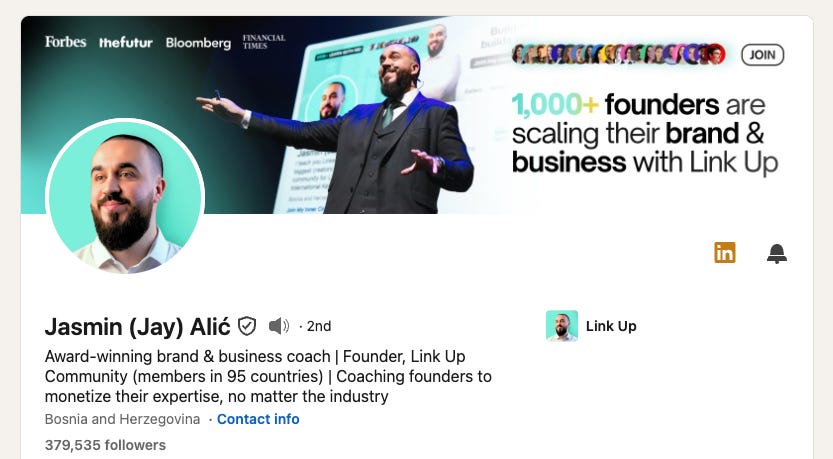
Your banner
This is the largest piece of real estate you own on the platform and most founders waste it on a company logo, which is boring and tells a stranger nothing.
Use words. Tell someone why they should keep scrolling. If you sell something, this should point at your core offer. If you have proof — recognizable logos, a number you’ve earned the right to claim — put it underneath, because a claim is more believable when it isn’t standing there by itself.
With the free version of Canva or Claude Design, it’s a twenty-minute job.
Here’s an example:
Your headshot
Get a real one. Professional photography is an investment, but you’ll use these images everywhere for years, and a good photo signals that you take your own growth seriously. Yes, there are great AI generated headshot options out there, but the real deal still beats it every time. In my experience, this is a $200-500 investment that is 100% worth it.
Your headline
This one has quietly become the highest-stakes field on your profile, because it’s one of the strongest signals the audience classification engine has about what you do.
Two mistakes I see constantly…
The first is being vague. “Founder of [Company]”, again, tells a stranger nothing if your company isn’t a household name. Mine certainly isn’t. Get specific about who you help and what changes for them.
The second is more subtle and more expensive: not properly optimizing for keywords. Pick the words you want to be found for and make sure they literally appear. If you want to be known for revenue operations, the phrase “revenue operations” needs to exist somewhere the machine can read it. It cannot infer what you meant by “accelerating growth”.
Your About section
This is where personality lives. Speak to the visitor, not at them in third person.
One addition since 2024: write this the way you’d write anything you want believed. Google’s own guidance on AI search rewards non-commodity content — unique, first-hand, experience-based writing over generic restatement — and the same instinct serves you here.
Specific beats clever. If you’ve worked with 40 companies in a particular category, say so plainly.
Check out my profile for an example.
Your Featured section
Most founders treat this like a highlight reel — events, press, customer reviews, the posts that performed. All good material, and none of it moves anybody anywhere.
The large majority of people landing on your profile aren’t ready to buy from you today. Maybe not this year. Which is exactly why this section exists.
Your Featured section has one job: turn a visitor into a follower or a subscriber. Three tiles, three ways in. Your newsletter or email list, your best lead magnet, and the highest-intent thing you own.
Not “here are three posts that performed.” Those were good posts. They aren’t a next step.
Your Experience section
It doesn’t need to read like a full resume. Tell people what you did and why it matters, briefly, and keep building credibility as they scroll.
See how brief this is:

Your Skills list — the one nobody checks
This is the one I’d bet most of you have never looked at, and it’s low hanging fruit.
Your profile displays a tidy “Top Skills” card near the top. That card is a display setting. Underneath it sits the actual Skills list, ordered, and that’s the one LinkedIn reads to decide what you’re genuinely expert in. Endorsements pile up on it across your whole career, long after the roles that earned them stopped being relevant.
So the founder who spent five years in enterprise sales before starting a product company may still be classified, quite confidently, as a salesperson.
Go look at yours right now. Reorder it so the category you’re building lives at the top, and delete the ones that stopped being true a decade ago. It takes about five minutes and it may be the fastest classification change available to you.
One asset, three jobs
Longtime readers know I’m a sucker for a GTM multivitamin — one initiative that pays into several funnel goals at once, which matters enormously when you have neither time nor budget to spare.
Your profile is one of the best examples of that.
One afternoon of work, three improved outcomes:
Human conversion. The visitor who just read your post and wants to know if you’re worth following.
Algorithmic distribution. The classification engine deciding who sees your next post in their feed or AI search.
Credibility behind the citation. Your posts are what AI engines reach for. Your profile is what holds up when someone follows the trail back to you.
The same way your website is your 24/7 salesperson for your company, your LinkedIn profile is working around the clock for you, too. It just picked up two new shifts.
How you’ll know it’s working
Not just profile views. Volume is tempting because it’s the number sitting right in front of you, but it’s the wrong scoreboard here.
For the next 90 days, watch who is showing up and what they do next. Newsletter subscribers. Lead magnet downloads. DMs from people who want to hire you or partner with you. The quantity and quality of the inbound – the people who took action.
If your profile views drop but the right people start landing, that’s a win. You’d rather be found by thirty of the right people than three hundred of the wrong ones.
What’s next
Your profile is the foundation. Now we build on it:
Part 2: Warming up your thought leadership muscles — how to start with low-pressure engagement before you write a single original post.
Part 3: Finding your tone and themes — the 4x4: four core values, four core themes, and why the riches are in the niches.
Part 4: Picking a cadence you’ll actually keep — realistic posting quotas, thematic days, and the 80/20 rule for value vs. promotion.
Questions? Send them over. I read every one.
With love and gratitude -

If you want to learn more about working with me directly…
For B2B startups I serve as a Fractional GTM executive or advisor. Learn more about-
When you’re ready, let’s connect to discuss your specific growth goals and challenges.
Subscribe for weekly education, ideas, and frameworks
In this newsletter I share the exact tips, playbooks, and GTM multi-vitamins I’ve used to help 30+ B2B startups scale their revenue 150-590% YoY.
Thanks for reading GTM for Startups by Jess! This post is public so feel free to share it.