

Hi friends — Another question I’ve received from founders dozens of times over the years:
“Should I put pricing on my website?”
And it usually comes wrapped in a fear — that showing the number will scare people off, or hand ammunition to competitors, or box the sales team in.
So I’ll do my best to answer it completely because the data here is loud, and the framework I recommend is simple and rational.
Should you put pricing on your website?
What the data says (spoiler: buyers want the number)
Your buyers are looking for pricing, and they’re frustrated when they can’t find it:
In the newly-released TrustRadius 2026 B2B Buying Disconnect Report (1,862 buyers surveyed in January 2026), transparent pricing ranked as buyers’ #1 wish-list item from vendors — for the fourth consecutive year. Four years running. Buyers could not be telling us more clearly.
Per Gartner’s March 2026 sales survey, 67% of B2B buyers now prefer a completely rep-free buying experience. Read that again: two-thirds of your buyers would rather never talk to sales. If the only way to learn your price is a sales call, you’ve built a wall between most of your market and the one thing they came for.
That same TrustRadius report found 63% of buyers used AI during their purchase journey, and 83% shortlisted three or fewer products. The research phase is self-serve, AI-assisted, and brutal — if your pricing story isn’t findable, you may never make the shortlist at all.
And this isn’t a new phenomenon — over a decade ago, Nielsen Norman Group’s usability research (2013) watched B2B buyers abandon sites that hid pricing and head straight to competitors, concluding that “people view companies that hide costs as being evasive and untrustworthy.” What’s changed since then isn’t the frustration. It’s that buyers now have better tools to find and act on it.
Remember: your website is your only 24/7 salesperson, and modern buyers do most of their journey on their own before they ever talk to you. A missing price doesn’t generate a phone call. It generates a bounce.
My framework: it should scale with your price point
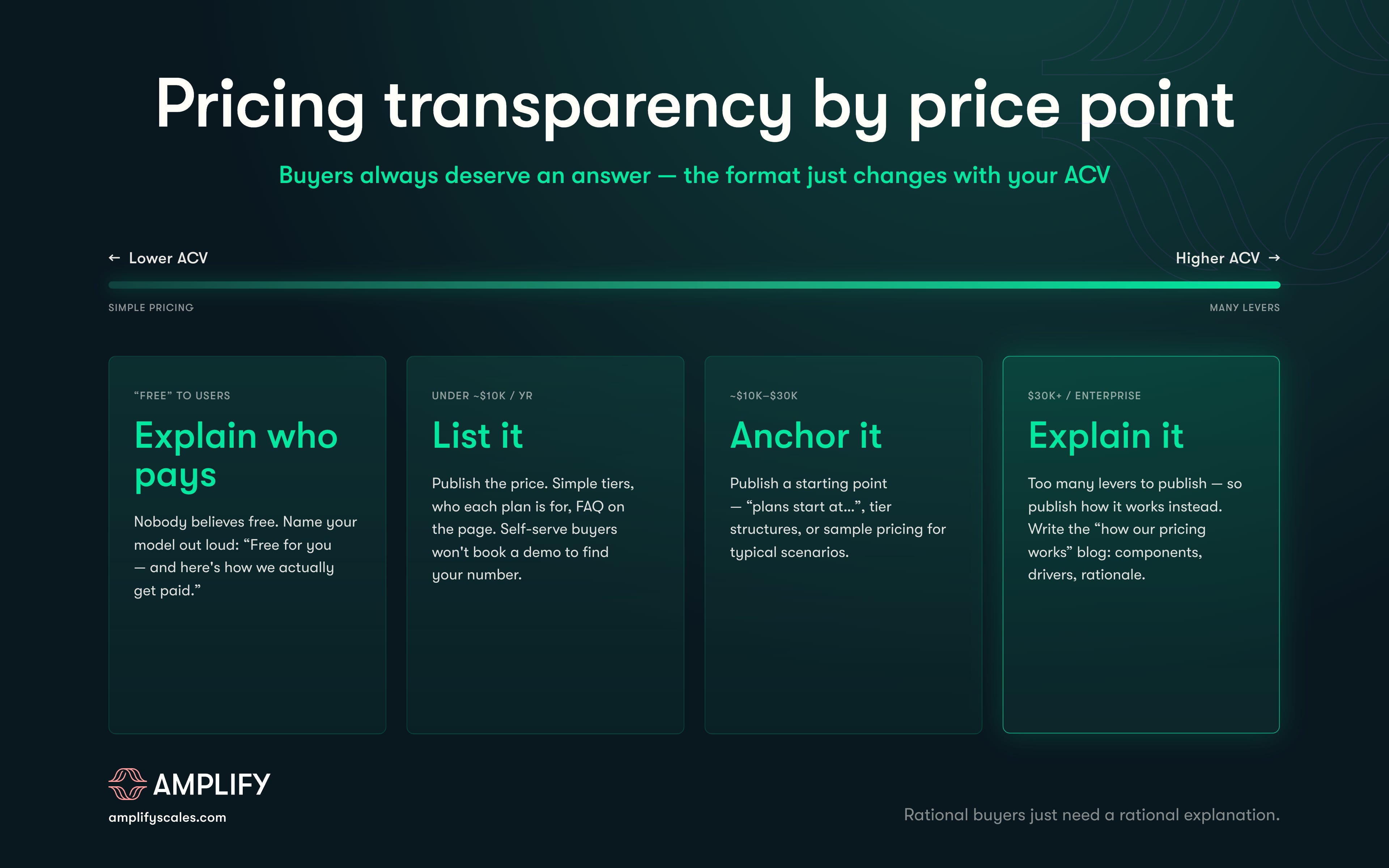
Here’s the honest nuance: buyer expectations shift with ACV. The same way your GTM motion should match your deal size, so should your pricing transparency:
Small price points (~$100/month, up to roughly $10K/year): list it. Your buyers are self-serve. They expect a pricing page the way they expect a login button, and they will not book a demo to learn what your Starter tier costs. At this price point, hiding the number just donates your traffic to whoever shows theirs. And once you’re listing it, structure the page well: keep it simple, three tiers is the tested sweet spot, label who each plan is for, and answer objections right on the page with an FAQ. A resource worth stealing from before you build it: MKT1’s pricing page guide (a full checklist plus real teardowns).
Mid-range deals (roughly $10K–$30K): anchor it. You may not be able to publish an exact figure for every visitor, but you can publish a starting point — “plans start at…”, tier structures, or sample pricing for typical scenarios. Then just include a CTA to get a custom quote.
Enterprise deals ($30K–$50K+, into the hundreds of thousands or more): explain it. At this level, buyers generally don’t expect a price tag on the website — scope varies too much, procurement is involved, and every deal is configured. (More on why that’s actually the buyer-friendly choice in a second.) But here’s what founders miss: not expecting a price tag is not the same as not wanting answers.
That last scenario is where most of my clients live — and it’s where I’ve learned to get creative.
The enterprise play: write the “how our pricing works” blog
Let’s be honest about why enterprise pricing isn’t on the website — because at this level, withholding the number often isn’t to be intentionally evasive. Publishing your full enterprise pricing would mean publishing the Cheesecake Factory menu: 10 pages of options, modifiers, and combinations that nobody actually wants to read.
When your pricing has that many levers — modules, seats, integrations, implementation scope, service tiers — dumping all of it on a page doesn’t create transparency. It creates friction and confusion. A confused buyer doesn’t feel informed; they feel overwhelmed, and overwhelmed buyers stall.
But here’s the thing: too many levers to publish the full menu is not the same as too many levers to explain how you bake the cake.
And this is where my core belief about buyers comes in: most buyers are rational people. They don’t need a custom quote right up front — they want a directionally accurate estimate and a rational explanation. Tell them what the levers are, in the simplest possible terms, and why those levers exist (”implementation varies because integrations vary” is a sentence anyone’s CFO can nod along to). Give a rational buyer a rational explanation and they don’t just understand your pricing — they trust you more for having explained it.
So when my clients can’t put a number on the website, here’s what I recommend instead: publish a blog post that explains how your pricing works. Not the exact figure — the structure: what the cost components are, what drives price up or down (and why), and what a typical engagement looks like at different sizes.
This one post does a shocking amount of work. It satisfies the self-serve researcher without forcing a sales call. It builds trust — you read as confident and transparent instead of evasive. It pre-qualifies (and kindly disqualifies) buyers before anyone’s calendar gets involved. It arms your internal champion with the “how does the pricing work” answer they need for their CFO. And with 63% of buyers now using AI in their purchase journey, it’s an AEO goldmine — “how much does [your company] cost” is exactly what buyers ask ChatGPT, and a first-hand, question-formatted explainer is exactly the content those engines cite. It’s the kind of blog that answers a real prospect question — which means it pays for itself in sales enablement even if it never ranks.
Here are two of my clients where we have run this play, in two different flavors:
Flavor 1: explain the cost drivers. Kooltra, an FX and treasury operations platform serving fintechs and banks, published “How much does Kooltra cost? Understanding our pricing structure”. Notice the title — it’s the literal question a buyer types. The post breaks their pricing into its two components (a one-time implementation fee and a recurring subscription), explains exactly what moves each number (modules deployed, users, integrations, complexity), and gives directional shape by team size — small, mid-market, enterprise. No exact quote, but a buyer leaves knowing how the math works and roughly where they’d land. That’s the confidence a champion needs to keep you on the shortlist — and may be the transparency that encourages them to book the demo.
Flavor 2: explain the pricing model. When, a workforce transitions platform redefining how employers manage benefits coverage changes, published “PEPM is predictable. Utilization is aligned. Why we offer both.” There’s not a single dollar figure in it. Instead it explains their two pricing models — a fixed per-employee-per-month rate vs. usage-based pricing — and, more importantly, the philosophy: who carries the risk under each model and why offering both is a buyer-centric design. A buyer finishes that post understanding exactly how they’d be charged and which model fits them, before any sales conversation happens.
Same play, two flavors: explain the drivers, or explain the model. Ideally, over time, you do both.
What to put in yours
If you’re writing your own pricing explainer blog, cover:
The cost components — what a buyer actually pays for (setup vs. recurring, licenses vs. usage, services vs. software).
What drives the price up or down — team size, modules, integrations, complexity. Buyers respect variables; they distrust mystery.
Directional shape if you can — ranges by company size, or “engagements typically start at…” Sample scenarios beat calculators.
Who you’re the right fit for — and who you’re not. Disqualification is equally important.
The questions you hear on every first call — answer them here and your first calls get better.
One more scenario: when your price is “free”
Sometimes the people who use your product aren’t the people who pay you. My former client PEO 360 is a perfect example. They help SMBs and mid-market businesses shop for a PEO — an unbiased guide through a genuinely confusing purchase. And for those businesses, the service costs nothing. PEO 360 gets compensated through a revenue share from whichever PEO their customer ultimately lands on. And because their compensation comes from the PEOs across the board — not from steering anyone toward a particular option — they stay a truly impartial advocate for the buyer.
Now here’s the trap in that model: just saying “our service is free!” and moving on will absolutely sound suss. Your buyers are rational people, remember — and rational people know nobody works for free. An unexplained “free” doesn’t read as generous; it reads as sketchy. What’s the catch? Whose side are you actually on?
So my advice to PEO 360 has been to be radically transparent about their model, everywhere they can: “Yes, our service is free for you — and here’s how we actually get paid.” Explaining the rev share doesn’t undermine trust. It’s the thing that creates it — because it answers the question every buyer is silently asking before that question curdles into suspicion.
Where to start
If your price point is small(er): just list it. This week. You’re bleeding visitor bounces every day it stays hidden.
If you’re mid-range: add a “starting at” anchor or tier structure to your site.
If you’re selling to enterprises: draft the “how our pricing works” post. Title it with the literal question — “How much does [you] cost?” — and answer it the way you would for a friendly prospect on a first call.
If you’re “free” to your users: disclose the “how we get paid” explainer. Name the model before your buyers name their suspicion.
Whatever your price point — $99 a month, six figures, or free — the principle is the same: buyers don’t need your exact number nearly as much as they need to trust you’re not hiding it. 💡
P.S. Is your pricing on your website today? If not — what’s the real reason? Hit reply and tell me. No judgment, and I’ll tell you which flavor of the play I’d run.
With love and gratitude -

If you want to learn more about working with me directly…
For B2B startups, we serve as your Fractional GTM executive or engineer. Learn more about -
When you’re ready, let’s connect to discuss your specific growth goals and challenges.
Subscribe for weekly education, ideas, and frameworks
In this newsletter I share the exact tips, playbooks, and GTM multi-vitamins I’ve used to help 30+ B2B startups scale their revenue 150-590% YoY.