

Hi friends — Happy Sunday!
If you’ve visited the site lately, you may have noticed things look a little different. After almost three years of writing this newsletter, the archive has grown to over 100 posts. That’s a lot of answers to a lot of founder questions, and it was getting hard to find the one you needed.
So I gave my Substack a facelift. There’s now a Playbooks menu at the top of the home page with six hubs, each organized around the questions founders ask me most:
Start with whichever problem is keeping you up at night right now. Each hub tells you where to start and what to read next.
Organizing the archive also got me reflecting on how this whole thing started, and why it’s become one of the most successful (and efficient) marketing tactics in my business.
So this week, I’m pulling back the curtain on my own B2B newsletter: how it started, the five jobs it does for me, and what I’d do if I were starting one today.
I organized 100+ posts into Playbooks. Here’s how this newsletter became my best marketing channel.
It started as a lead magnet for something else
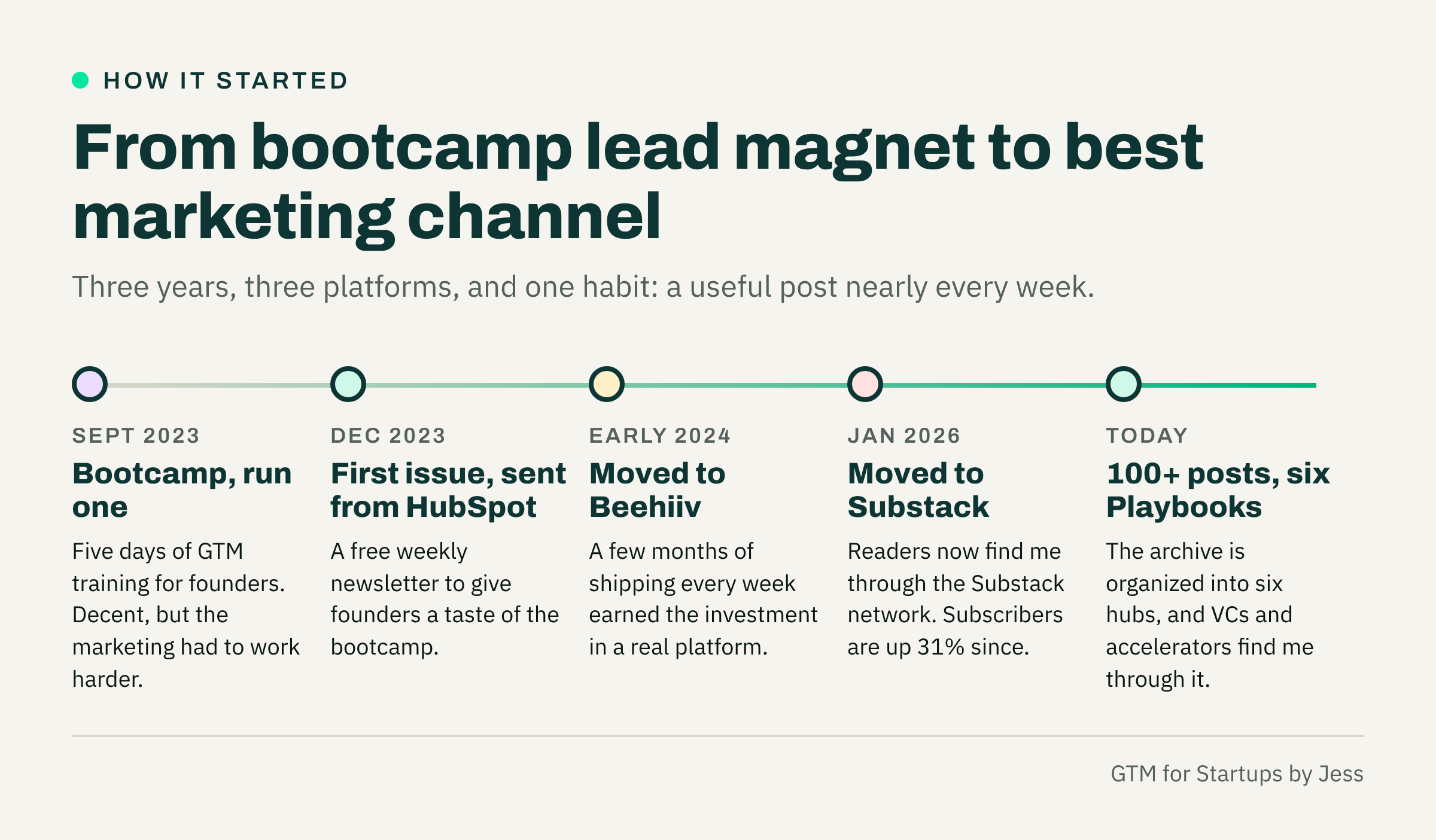
In September 2023, I ran a five-day virtual GTM bootcamp for founders. One module a day, covering the same frameworks I use with clients, from marketing and PR to outbound, RevOps, and hiring.
It went well. Financially, it was… fine. Moderate success. Good enough to run again, but the marketing needed to work harder for it to be worth my time.
So before the second run in February 2024, I tried something new. I started a free weekly newsletter.
The logic was simple: if founders could learn from me for free every week, they’d get a taste of what the bootcamp would be like and be more likely to sign up for the paid version. A free sample to sell the full meal.
The bootcamp ultimately changed its shape: I stopped selling the bootcamp to founders directly. Now VCs, universities, and accelerators bring me in to deliver the content to the founders in their portfolio or network. And instead of the general version I started with, I often customize it to the needs of each specific cohort.
The newsletter, meanwhile, took on a life of its own. It was well received from the start by founders and investors, so I kept writing. Funny enough, it’s now how a lot of VCs and accelerators find me and end up hiring me to run the bootcamp for their founders. Almost three years later, it’s one of the best investments I’ve made in my business.
p.s. If you run a fund or an accelerator and want to bring bootcamp-style GTM training to your founders, learn more about my speaking and workshops here.
Why a B2B newsletter works: one asset, five jobs
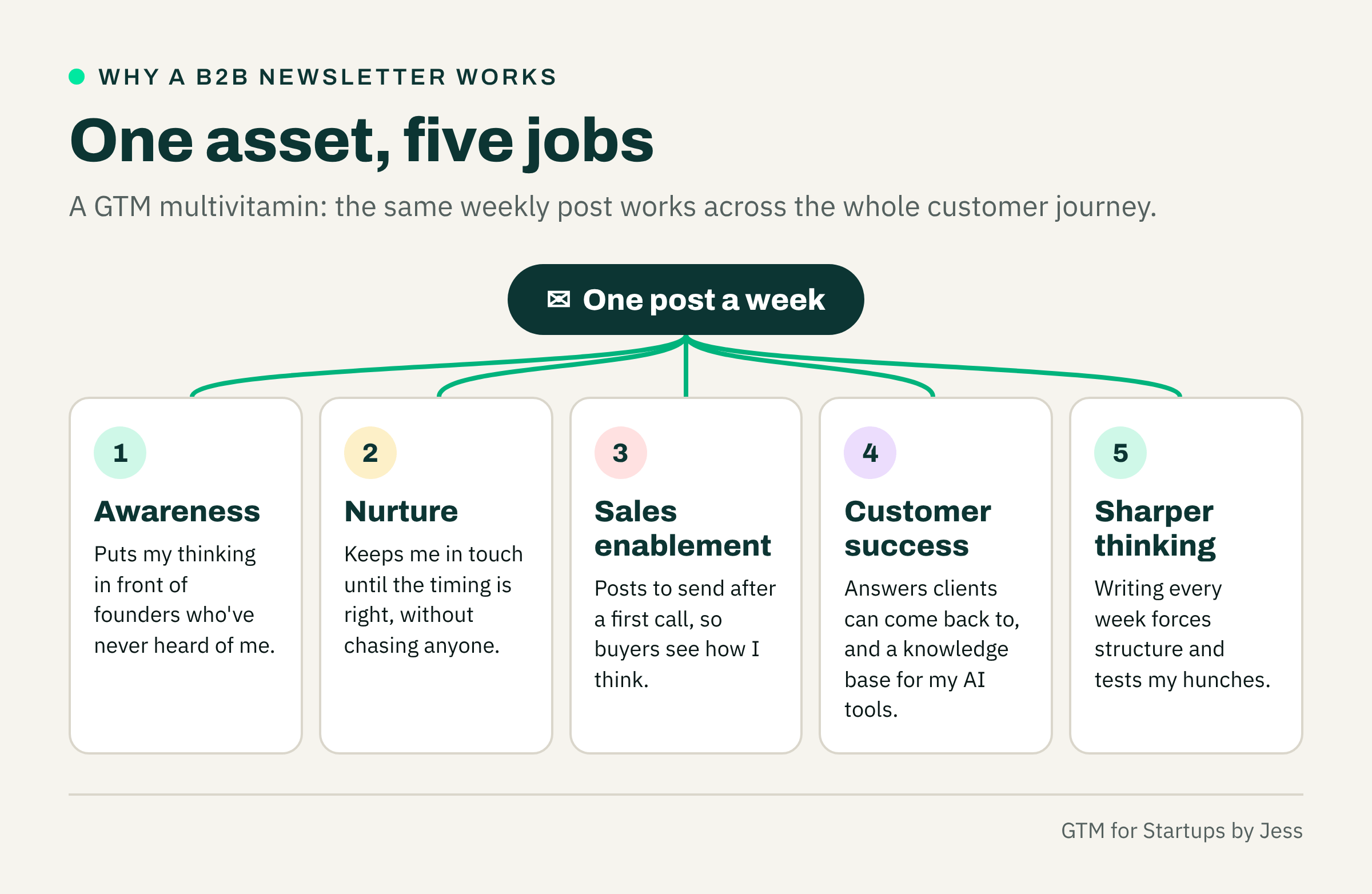
If you’ve been reading for a while, you know I’m a big believer in GTM multivitamins: tactics that deliver several benefits at once. This newsletter is the best multivitamin I’ve ever taken. Here’s every job it does for me:
1. It helps new people find me
Every week, the newsletter puts my thinking in front of founders who’ve never heard of me. They find a post through LinkedIn, search, a share, a recommendation from another writer, or the Substack app. It’s an evergreen top-of-funnel awareness tactic.
2. It keeps me in touch with founders until the timing is right
This one’s my favorite. I can’t tell you how many times I’ve talked to a founder who wasn’t quite ready to hire me. Maybe they were too early, or the budget wasn’t there yet. So they subscribe, and they get the newsletter nearly every week.
Then, sometimes years later, they raise their hand and say, “Now is the right time.”
That’s the beauty of it. You stay in touch without chasing anyone. Every week, they get to know a little more about how I think and what I recommend. By the time they reach out, the trust is already there.
And it scales. Instead of following up with every founder one by one, I stay in touch with all of them through one post a week, in one channel. It’s the best nurture program I could have built, and I never had to send a single “just checking in” email.
3. It’s a sales enablement asset
After a first meeting with a founder, I’ll often send a handful of posts that speak to their challenges we discussed. It gives them a real taste of what it’s like to work with me, and how I think through problems like theirs, before they’ve spent a dollar. Instead of building one-off sales collateral, I have years of it ready to send for nearly every common scenario.
4. It supports my active client engagements
The newsletter has quietly become a customer success asset too. When a client asks how to run a QBR, structure their deal stages, or ramp their first marketer, I point them to the post. It saves time on both sides and gives the team something to come back to later. (Same idea as a product help library, just in consultant form.)
I’ve also turned years of documented thinking into a knowledge base that feeds the AI tools I use across my client engagements and proposals. The posts are the starting point. The context and judgment I bring to each client is what turns them into results.
5. It makes me a better thinker
I’m not the first person to say this. The historian David McCullough put it best: “Writing is thinking. To write well is to think clearly. That’s why it’s so hard.”
Writing every week forces me to put structure around ideas I’ve been carrying around in my head. It also forces me to test my intuition. When I have a hunch about what works, I go looking for the data to back it up, and sometimes the data surprises me. Either way, the advice gets sharper.
How I come up with topics (hint: my customers do)
People often ask me how I find something new to write about every week. Honestly? My prospects and customers hand it to me.
Every topic comes from one of two places:
Active sales conversations. The challenges founders bring to a first call, and the questions they ask before they buy.
Active client engagements. The problems my clients are running into, and how I guide them through each one.
After five years of fractional work, I have a deep well of both. When the same question keeps coming up, that’s next week’s post.
If your current customers have a challenge or a question, your prospective customers almost certainly do too. That makes your sales and customer conversations the best input you have for a content strategy. Look for the themes, and you’ll never run out of topics.
💡 Founder Self-Check: What are the three questions you’ve answered most often on sales calls this month? If you can name them, you have your next three posts.
Why it’s been so successful
1. I give 90% and sell 10%
I never hard sell in this newsletter. That’s on purpose.
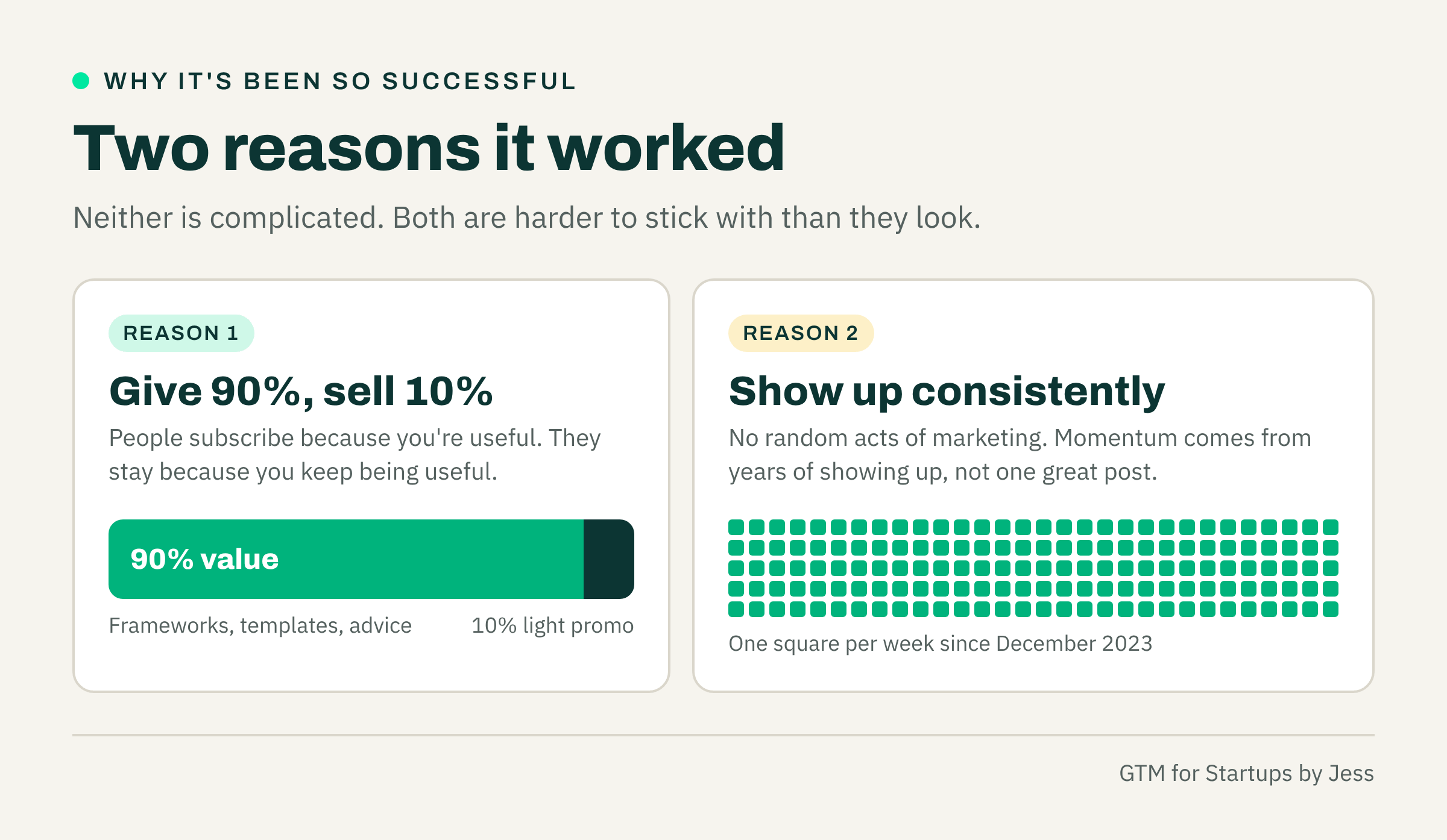
Is there subtle selling? Of course. The footer tells you how to work with me, and some posts are a little more promotional than others. But roughly 90% of what I’ve written has been pure value: frameworks, templates, and the exact advice I’d give a client.
That’s what I’d recommend to anyone starting a newsletter. People subscribe because you’re useful. They stay because you keep being useful. The moment your newsletter reads like a sales pitch, you’ve lost the thing that made it work.
2. I’ve been consistent
The other big reason it works: I’ve shown up nearly every week since December 2023.
This is something I drive home with clients all the time. You can’t do random acts of marketing. Whatever you commit to, you have to do it consistently for it to build momentum and pay off. That’s true for a newsletter, for SEO, and for just about any other go-to-market strategy. One great post won’t move the needle. Years of showing up will.
Which platform should you use? HubSpot vs. Beehiiv vs. Substack
Since consistency is the whole game, the platform matters less than you’d think. Step one is making sure you can commit to showing up before you invest much time, energy, or money in a tool.
That’s why I started in HubSpot. I already paid for it, and I wanted to prove to myself that I could write every week before I invested in a new platform. I sent the first issue on December 5, 2023.
After two or three months of shipping consistently, I trusted myself enough to invest, and I moved to Beehiiv. It’s a great platform. The interface is more tech-forward, and the reporting is excellent. I genuinely liked using it.
But on Beehiiv, your newsletter lives in its own universe on the internet. Substack is different. Your newsletter is part of the Substack app, which works like its own social network. Readers discover you through the app, recommendations, and other writers they already follow.
So I moved to Substack this January, and the difference showed up fast:
My subscriber base has grown about 31% since the move.
In the last 90 days, roughly 85% of new subscribers found me through the Substack network.
My advice: start with whatever tool you already have, and only move to a newsletter-specific platform once you know you’ll keep showing up.
Where to start
If you’re thinking about starting a newsletter for your startup, here’s how I’d do it. Good, better, best:
Good: Keep a running list of the questions you answer on every sales call and customer conversation. That list is your content strategy.
Better: Answer one of those questions every week, in whatever tool you already have. Prove to yourself you can stay consistent for a few months before you pay for anything new.
Best: Once you’re consistent, move to a newsletter platform that helps people find you, and organize your archive so readers can find the right answer when they need it. That’s exactly why I built the Playbooks menu I mentioned at the top of this post.
✅ Recommended action: This week, write down the five questions you hear most from prospects and customers. Pick one, and write the answer as if you were emailing a founder friend. That’s your first issue.
If you’re new here, the Marketing for B2B startups playbook is a great place to start. It covers founder thought leadership, content marketing, and what to prioritize at each stage.
And thank you, sincerely, for reading every week. Some of you have been here since that very first HubSpot send, and I don’t take it for granted. 🙏
With love and gratitude -

If you want to learn more about working with me directly…
For B2B startups I serve as a Fractional GTM executive or advisor. Learn more about-
When you’re ready, let’s connect to discuss your specific growth goals and challenges.
Subscribe for weekly education, ideas, and frameworks
In this newsletter I share the exact tips, playbooks, and GTM multi-vitamins I’ve used to help 30+ B2B startups scale their revenue 150-590% YoY.