
When to introduce paid ads to your marketing strategy
Hint: Business maturity + product maturity + marketing maturity


Hi friends - I hope you enjoyed learning all about brand from Bill! He is a wealth of knowledge and very active on LinkedIn, so give him a follow to stay connected and keep learning.
Next up in our expert guest roster is Mr Peter Guba, Founder of Profit Mill, to teach us all about paid ads.
Peter spent over eight years at Google, where he worked with more than 1,000 clients. He worked on three distinct teams, supporting a range of clients—from small businesses with no experience in running paid ads, to mid-sized and large performance advertisers with multimillion-dollar profitable ad spends. During that time, he’s seen hundreds of scenarios where paid ads failed, and hundreds of scenarios where paid ads succeeded, and he will share everything he’s learned through this experience in the coming newsletter emails.
There is a set of questions that almost all clients would always ask before starting with paid ads. This week he’ll start by answering a burning question many of you might have…”When should I introduce paid ads?”.
Let’s dig in. 👀
When should I introduce paid ads to my marketing strategy?
When you can confidently check all 3 of these boxes -
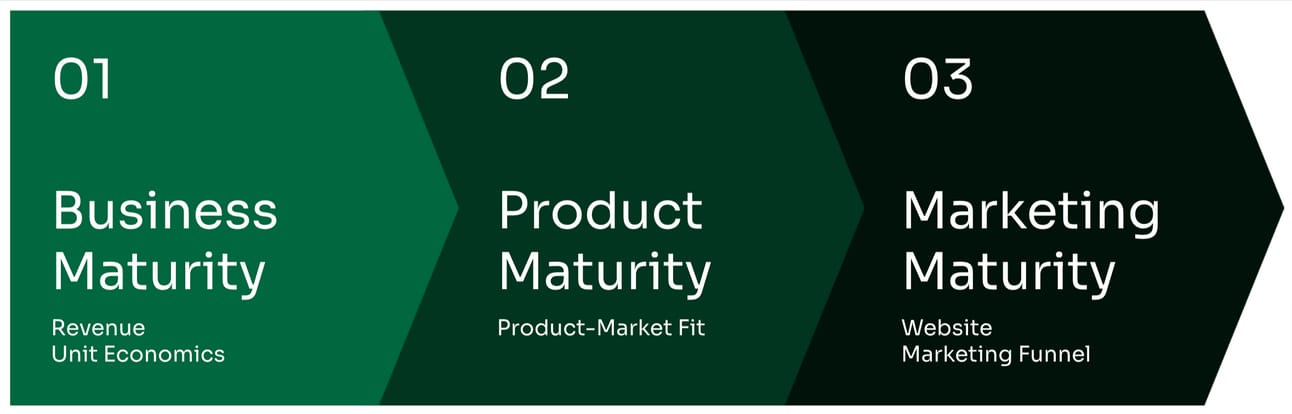
Then, and only then, when you can confidently say you meet all of the necessary criteria, will you be in a good position to invest in paid ads.
Let’s unpack each of these further.
Business Maturity
Let’s discuss the general feasibility of this initiative based on your financing model, revenue, and budget.
You will need to allocate a specific budget to paid ads, which means you need sufficient revenue (or funding) to sustain this endeavor long enough to see results.
If you are self-funded, your requirement for revenue will be higher since you’ll be investing directly from your profits. If you are VC-funded, you may be able to pursue this strategy while operating at a loss or with significantly less revenue.
To address the question above, you must understand your business metrics, including your target ROAS, target CAC, target payback period, and LTV. These metrics are crucial for setting up your paid ads strategy and evaluating its success efficiently.
Here’s how these metrics help answer key questions:
Product Maturity
✅ When you have product-market fit
Ads can help scale a proven product, but they won’t fix underlying product issues. If you have a poor-quality product with high churn, you may invest in marketing to acquire leads, but those leads are unlikely to convert into customers.
✅ When you have a clear value proposition
Paid ads amplify your message, so a well-defined value proposition is critical to stand out in a competitive market. When the product's value is unclear and not easily realized during use, we end up spending money to acquire customers, only to see them churn or fail to convert into customers in the first place.
Marketing Maturity
✅ When you have a marketing funnel in place
Paid ads are most effective when you can nurture prospects through every stage of the buyer's journey.
This includes:
Case studies you can share to build trust
Email drip campaigns to engage and convert leads over time
Social proof, such as testimonials or reviews, to boost close rates
✅ When your website or landing page is optimized
Paid ads can drive significant traffic, but poorly optimized destinations waste ad spend.
To ensure success:
Include clear CTAs (calls to action) above the fold to encourage lead generation.
Ensure a smooth user experience, from navigation to form submissions, to reduce friction.
Your website is your only 24-7 salesperson.
Jess Schultz
A quick gut check…
When you have strong organic marketing performance:
Organic marketing provides valuable insights into what resonates with your audience, reducing the risk of launching ineffective ad campaigns. If your organic channels are thriving, paid ads can amplify what’s already working.
When competitors are using paid ads successfully:
Observing competitors’ success with paid ads can be a strong indicator of potential in your market. However, just because they are running paid ads doesn’t mean they are doing so profitably or effectively; they might only be running ads temporarily before eventually abandoning the effort due to lack of results.
If you are seeing healthy organic acquisition and long-term investment in paid ads from your competitors, this could indicate a promising opportunity to advertise on paid ads—provided all the necessary requirements for success mentioned above are also in place.
If you meet some of the requirements but not others, you may still be able to launch paid ads relatively quickly. Certain requirements can be addressed more easily than others:
Marketing elements → turn that blog into a case study, contact your clients for reviews, spin up a drip campaign, or hire a freelancer to tweak your website.
Clear value proposition → spend some time thinking through this, there are templates and frameworks available online, heck, brainstorm with ChatGPT!
Business metrics → you probably already have at least a rough estimate of your core business metrics, start there and see if you can do some basic math to get decently accurate numbers
For the areas above, focus on achieving "good enough" rather than perfection.
However, two critical factors require more substantial effort and have no quick fixes:
Product-market fit
Revenue generation
These elements demand significant work and time to develop properly. Without a strong foundation in these areas, launching paid ads will be unequivocally premature.
See ya next week!
With love and gratitude -

If you want to learn more about working with me directly…
For B2B startups I serve as a Fractional GTM executive or advisor. Learn more about-
When you’re ready, let’s connect to discuss your specific growth goals and challenges.
Subscribe for weekly education, ideas, and frameworks
In this newsletter I share the exact tips, playbooks, and GTM multi-vitamins I’ve used to help 30+ B2B startups scale their revenue 150-590% YoY.
Thanks for reading GTM for Startups by Jess! This post is public so feel free to share it.
 |
|