

Hi friends — A while back I spent $10k with a niche service provider on a PR initiative. If you looked at that deal in their CRM, you’d see a tidy little win: inbound lead, contract signed in about two weeks. Easy deal, right?
Except my buyer journey started two years earlier. Let’s examine 👀
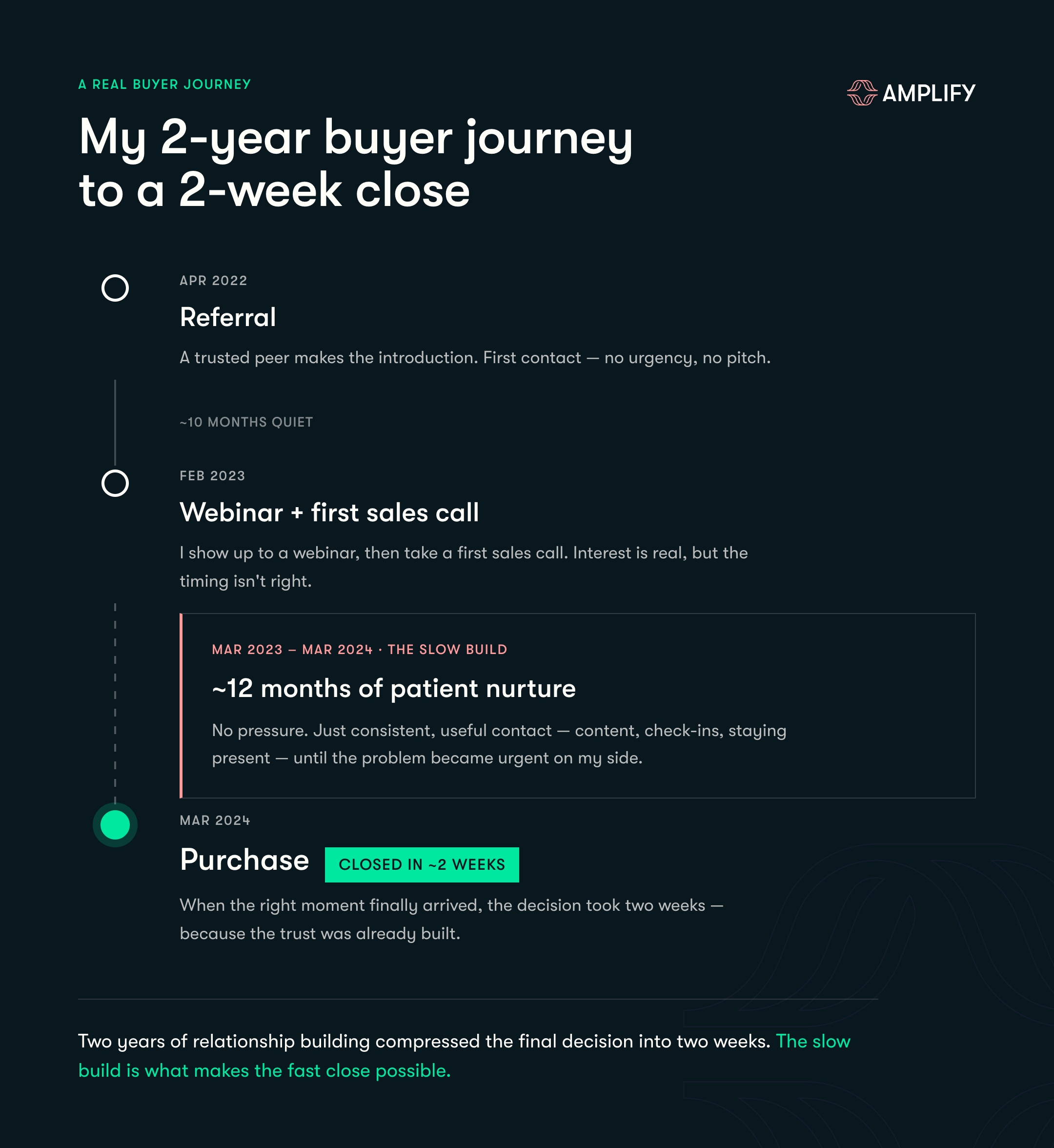
April 2022 — A peer recommended them verbally. I visited their website, was impressed… and wasn’t ready to buy. I signed up for their newsletter so I wouldn’t lose sight of them.
Feb 2023 — Through that newsletter, I learned they were hosting a free webinar. I attended, stayed impressed, and booked a sales call to learn more. Still didn’t buy — I was mid-investment in a rebrand at the time and couldn’t afford both, in dollars or capacity.
Mar 2023 – Mar 2024 — I saw their social posts, listened to their podcast, and got to know them a little more every week. All on my own.
Mar 2024 — I was ready. I reached out and signed within ~2 weeks.
Two years of trust-building. Two weeks of “selling.”
Now here’s the uncomfortable question:
How many people on your sales team have ever lived on the buyer side of that timeline?
Let me give you some tips on how to educate your team with data you already have.
Your sellers have never been buyers (here’s how to fix that)
Most sellers have never been buyers
Think about it. Most salespeople — especially earlier in their careers — have never held a budget, never had to justify a $10k (or $100k) purchase to themselves or an executive team, never felt the risk of picking the wrong vendor with money they’re accountable for. Many of them have spent their whole career on one side of the table.
So they do what the incentives teach them to do: chase the “now.” Push for the close. Treat a not-yet as a no. Get frustrated when a great call goes quiet. And — this is the one that costs you — quietly dismiss marketing as the fluffy stuff that doesn’t close deals.
None of that is malice. It’s just missing experience. Hell, most buyers don’t know how to buy — and most sellers have never felt what buying is actually like: nonlinear, interrupted, budget-constrained, and driven by trust built in places sales doesn’t always appreciate (or maybe even see).
What my two-year journey should teach your sellers
The stall had nothing to do with the seller. In Feb 2023 I was a warm, impressed, engaged prospect who took a sales call and didn’t buy. Not because the pitch failed, not because the price point wasn’t appropriate, not because I didn’t trust them — because of my own budget and capacity. If that rep had “pushed harder,” they wouldn’t have accelerated the deal. They’d have annoyed me. Sometimes a deal stalls on the buyer’s side of the table, and no discount or case study will fix it.
“Not now” is not “no.” I was in their pipeline for 13 more months — somewhat invisibly. They would have seen me opening marketing emails if they were looking, but there were no form fills, no replies, no meetings. A rep looking at their CRM might’ve marked me cold, but I was actually warming up the entire time.
The close was fast because the journey was long. That 2-week sales cycle only exists because of the 23 months of consistent presence that preceded it. Nobody “closed” me. They earned me — weekly, quietly, for two years. Trust and timing are everything.
And what it should teach them about marketing
Count the touches in my story. Sales touched the deal exactly twice: one call in early 2023 that “didn’t convert,” and two weeks of paperwork a year later. Marketing carried everything else — the newsletter that kept them in my inbox, the webinar that deepened my confidence, the social posts and podcast that made me feel like I knew them. That’s ~23 months of relationship held at zero incremental sales effort.
This is the thing sellers (and honestly, plenty of founders) get wrong about marketing: only a small slice of your TAM is ready to buy right now. Marketing’s job isn’t to close today’s 5% — it’s to stay in the peripheral view of the other 95% until their timing changes. When sales dismisses marketing, they’re dismissing the machine that delivers them “easy” 2-week closes.
And your CRM will mislead you if you don’t know what you’re looking for. Many would’ve logged: source — inbound; cycle — 14 days. The original source was a referral plus two years of email and content contributing to the attribution. If you only trust last-touch attribution, you’ll starve the exact engine producing your best deals.
The exercise: walk your sellers through your own purchases
Here’s the good news — you have a free, perfect teaching tool sitting in your own books: the buying decisions your company already made.
You buy things constantly. Software, insurance, an agency, payroll, that consultant last quarter. Pick two or three recent purchases (ideally at least one considered, expensive one) and walk your sales team through each journey, start to finish.
In your next team meeting, put one purchase on the screen and answer these together:
How did we first hear about this vendor — and how long ago was that?
How long between first touch and signature? (Longer than you remember. Check the email history.)
Where did we stall — and was the stall anything the seller could control?
What kept us warm during the quiet stretch? What content did we consume that they never knew about?
What did the vendor do that built trust — and what almost annoyed us out of the deal?
What actually triggered the purchase — and was it sales, marketing, or our own timing?
How or why did we ultimately choose this vendor vs their competitors?
Honest one: would a cold email from this vendor have worked on us in month 6? Why not — and what does that mean for our own outbound?
Then flip it. Take your last three closed-won deals and re-tell them from the buyer’s side using the same questions — you’ll be rebuilding your buyers’ actual journey instead of your pipeline’s version of it.
What changes after this exercise: reps stop treating silence as death and start treating it as nurture.
Follow-ups have more empathy and are more useful. Discovery questions get more human — because your sellers have finally been the human on the other side. And the next time marketing asks for budget, your sales team might be the ones making the case.
Where to start
Pick one recent considered purchase your company made. Map its full timeline — first touch to signature — before your next sales meeting.
Run the questions above with your team for 30 minutes. Let them react. The “would cold outreach have worked on us?” question always lands the hardest.
Make it a habit: one buying-decision teardown per quarter. Your business keeps buying things — keep learning from it.
Your sellers need to understand what it feels like to be a buyer — and what it feels like to be truly understood and earned. 🤝
P.S. What’s the longest YOUR buyer journey has ever been on something you eventually bought? Hit reply and tell me — I’m collecting these stories.
With love and gratitude -

If you want to learn more about working with me directly…
For B2B startups, we serve as your Fractional GTM executive or engineer. Learn more about -
When you’re ready, let’s connect to discuss your specific growth goals and challenges.
Subscribe for weekly education, ideas, and frameworks
In this newsletter I share the exact tips, playbooks, and GTM multi-vitamins I’ve used to help 30+ B2B startups scale their revenue 150-590% YoY.